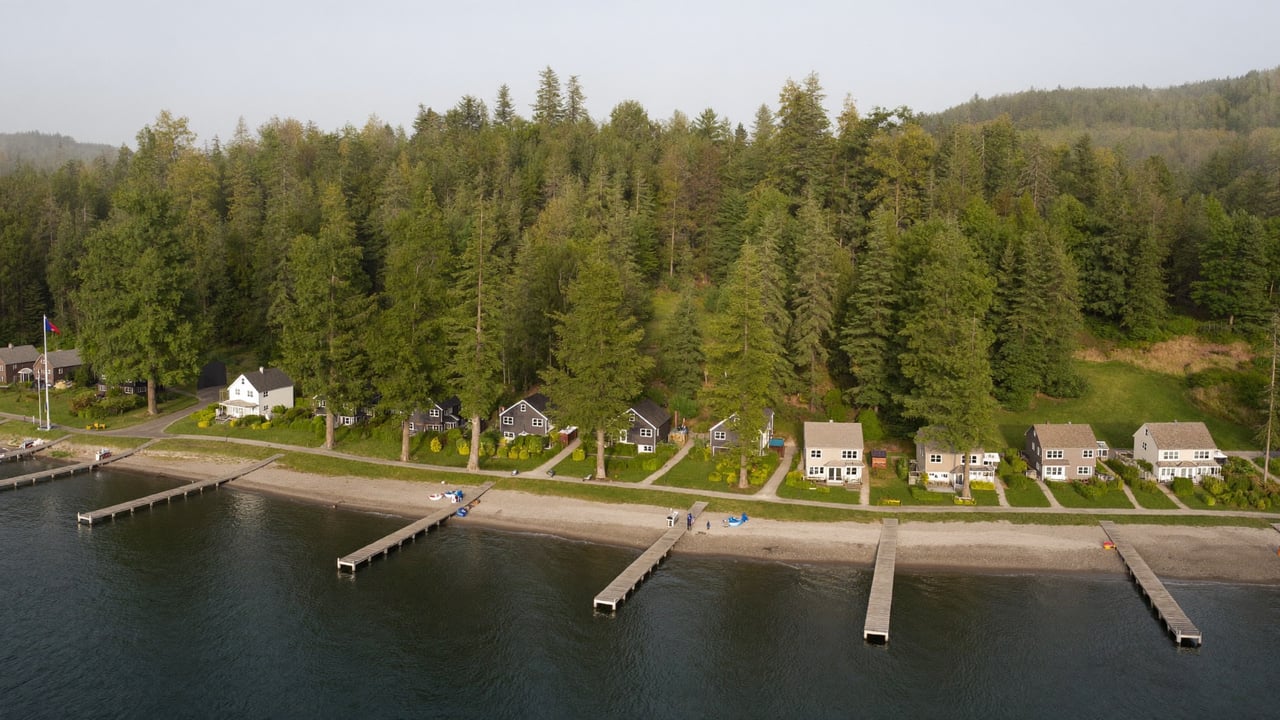
Most owners who ask about renting out a Candlewood lake house are really asking three different questions at once, and the answers pull in opposite directions. How much can it earn. How much of my summer does it cost me. And what am I allowed to do in my town.
There is a single line in Connecticut law that sorts most of it out, and almost nobody brings it up until after the decision is made.
The thirty day line decides which set of rules you are under
Connecticut defines a short term rental as the transfer, for consideration, of occupancy in a furnished residence for a period of thirty consecutive calendar days or less. That definition sits in CGS Sec. 12-408h, and the word that matters is "less." The line is inclusive, so a thirty day summer rental falls inside the short term category rather than outside it.
Cross that line in the other direction, to thirty one days or more, and the arrangement stops being a short term rental in the statutory sense. It becomes a lease. Different paperwork, different tax treatment, and critically, a different relationship with your town's ordinances.
That is the whole fork. Everything below follows from which side of it you land on.
Three structures, and what each one actually commits you to
The annual lease
One tenant, twelve months, a signed lease. This is the quietest version of owning a rental. You get a predictable monthly number, one set of move in and move out inspections a year, and the least wear on the house because nobody is treating it like a holiday.
What it costs you is the lake. An annual lease means you do not get your own dock in July. For a family that bought the place to use it, that is usually the end of the conversation. For an owner holding the property as an investment, or someone who inherited a lake house they cannot get to, it is often the only structure that makes sense.
The seasonal lease
This is the structure most Candlewood owners actually want and the one they most often describe incorrectly. A seasonal lease rents the peak months at a premium and hands the house back afterward.
The detail that decides whether it works: if your season is thirty one days or longer, you are writing a lease, not running a short term rental, and the town ordinance aimed at short term rentals does not reach you. If you chop the same summer into a series of two and three week bookings, every one of those is a short term rental, and you have moved yourself under a completely different rule set without changing the house or the guests.
Same property, same months, same money, and a different legal posture entirely, decided by how you divide the calendar.
Short term, the one people picture first
Weekly and weekend bookings through the vacation platforms. It has the highest headline nightly number and the highest everything else: turnovers, cleaning, pricing decisions, guest screening, and full exposure to whatever your town has written.
Here is the part worth reading twice, because it is the single most common mistake I see. A town having no short term rental ordinance is not the same as a town permitting short term rentals. Those two situations look identical from the outside and are not remotely the same risk. Connecticut has not written a statewide licensing scheme. Public Act 24-143, Section 7, effective October 1 2024, went the other way and explicitly authorized municipalities to adopt their own ordinances and require licensure if they vote to.
So the state handed the question to the towns, and the towns are not uniform. Brookfield, for one, limits a short term rental to no more than thirty consecutive days in any six month period and caps a property at three such rentals per six month period. That is a hard ceiling on annual rental income that you would never infer from the state definition, and it is written at the town level where most owners never think to look.
I wrote the full town by town version of this separately, including what the Office of Legislative Research actually said about how little the state has done: short term rentals on Candlewood, check your town, not the state list. If you are seriously considering the short term route, read that before you read anything else.
What a lake rental is priced on, and it is not square footage
Rental pricing on Candlewood follows the same logic as sale pricing here, which is to say it does not follow the logic that works inland. Two houses of the same size and finish, a quarter mile apart, can carry very different rents.
What actually moves the number:
- Whether there is a dock, and whether it is included in the rental. A dock in the listing photos is not automatically included, and on some parts of the lake it is not the owner's to give in the first place.
- Direct waterfront versus lake community versus near the lake. These are three different products, not three grades of one product.
- Furnished or not. A seasonal lake tenant is generally not moving furniture in for ten weeks.
- Which weeks. The season is short here and the middle of it carries most of the value.
None of that comes out of a per square foot calculation. It comes out of what comparable homes actually leased for, which is a different question from what they were listed at.
The seasonal detail that catches new owners
The lake is drawn down every winter, and in some years considerably further than the routine schedule. If your rental plan assumes a dock is usable, it is worth knowing what the water is doing on either side of your season before you write dates into a lease. I covered what changed most recently in the 2026 deep drawdown.
Common questions
Is a thirty day rental a short term rental in Connecticut? Yes. The statutory definition is thirty consecutive calendar days or less, so thirty days is inside the definition. Thirty one days is not.
Does my town allow short term rentals? That has to be checked town by town, and the absence of an ordinance is not permission. Brookfield and New Fairfield have both adopted short term rental rules. For the remaining towns nothing is established here either way, and a town's absence from a state survey is not evidence that it has written nothing. That survey was already wrong about Brookfield. Ask the town's land use office about the specific address.
Can I rent out just the summer and use the house the rest of the year? Yes, and for most Candlewood owners that is the structure worth looking at first. Keep the term at thirty one days or longer and it is a lease rather than a short term rental.
What is my lake house worth as a rental? It depends on dock rights, waterfront position and the weeks you are willing to give up, not on size alone. The honest answer needs comparable leased properties rather than an estimate.
If you are weighing this for a specific house, the useful conversation is about your dock, your weeks and your town, in that order. Reach me through ConnorCTHomes.com.
Connor Kostyra, Licensed Real Estate Salesperson, CT Lic. RES.0836348.
Connor CT Homes is a marketing brand. Real estate services are provided through RE/MAX Rise, 1297 Main Street, Watertown, CT 06795.
This article is general information, not legal advice, and not tax advice. Connecticut short term rental law and municipal ordinances change, and the rules that govern a property are the ones written by its own town. Confirm current requirements with your town land use office and with your own attorney and accountant before relying on anything here.