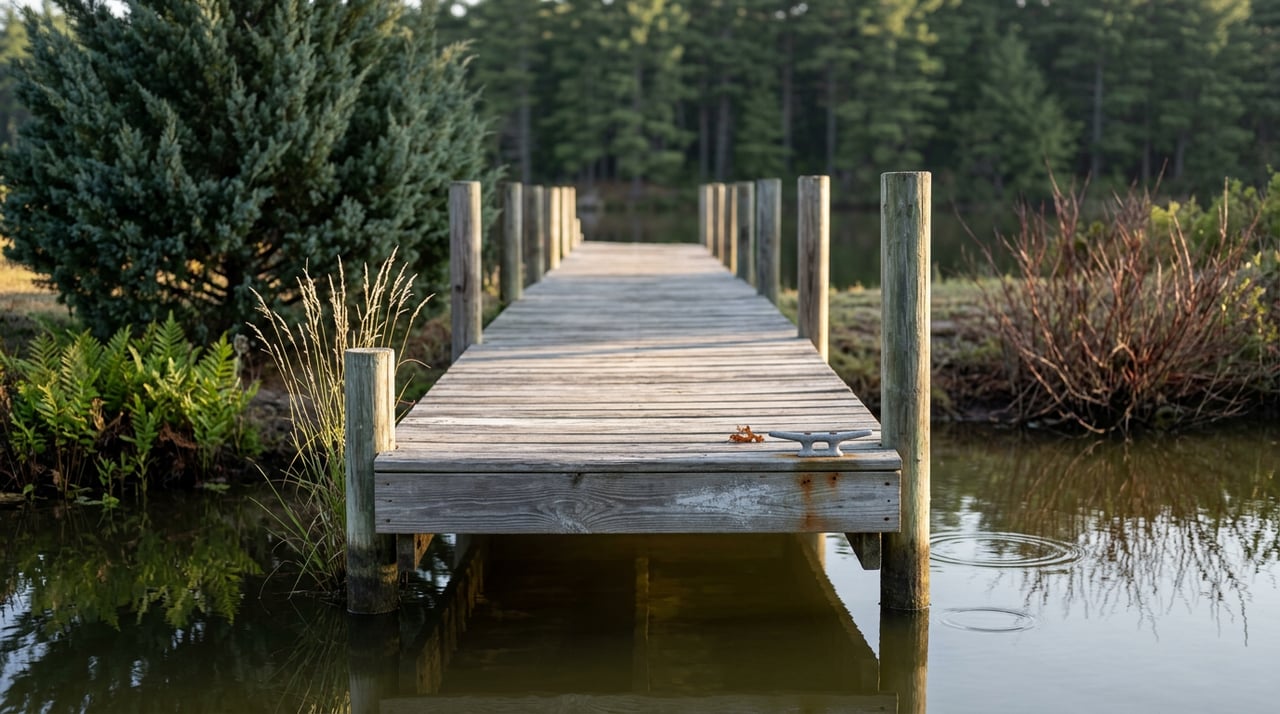
A buyer under contract on a Sherman waterfront property last spring did what most people do during the inspection period: walked the dock, checked the pilings, took a few photos for the file. What the inspector actually flagged wasn't the dock's condition. It was a question nobody on the buying side had thought to ask. Who owns the land the dock sits on?
The answer, on Candlewood Lake, is almost never "the seller." And that single fact changes how a Sherman waterfront purchase needs to be handled from the first showing to the closing table.
The Property Line Nobody Owns Past
Candlewood Lake is a reservoir, not a natural lake. It was built between 1926 and 1928 by Connecticut Light and Power to store water for hydroelectric generation at the Rocky River station, and the company that owns it today, FirstLight Power, took over in 2006. That ownership history matters because of where it draws the line, literally.
Most waterfront deeds on Candlewood Lake extend to what's called the Rocky River Project Boundary, an elevation mark long known around the lake as "the 440 line." Below that boundary, the land and everything on it, including most docks, belongs to FirstLight, not to the homeowner. About 95 percent of waterfront owners on the lake own down to that boundary and no further, and the boundary doesn't perfectly track the 440-foot elevation everywhere. In places it shifts, which is why a licensed survey, not just the tax map, is the only reliable way to know exactly where a specific Sherman parcel actually ends.
So when a listing shows a dock reaching into the water, that dock is very likely sitting on land the seller never owned in the first place. What the seller owns instead is either a deeded right to have a dock there, a permit from FirstLight allowing one, or in some cases neither, just a structure that's been there long enough that nobody's asked.
Three Ways a Sherman Dock Actually Belongs to Someone
Not all lake rights work the same way, and the difference matters more at closing than it does in a listing description.
In some Sherman communities, including Orchard Rest, certain homes without direct water frontage still carry a boat slip that's deeded to the property. When the home sells, that slip transfers with the deed the same way an easement would. This is the cleanest version of lake access because it's already recorded and it doesn't depend on anyone's goodwill.
In other lake communities, access works through a shared marina or a mooring field managed by the community itself. When an owner sells, the slip or mooring doesn't automatically pass to the buyer. It reverts to the association and goes back onto a waiting list for the next person in line. A buyer who assumes they're getting the same dock access the seller enjoyed can be in for a surprise here, because that access was never theirs to sell.
Then there's the FirstLight layer, which sits on top of both of the above. Even a homeowner with a fully deeded dock right still needs a current permit from FirstLight for the physical structure itself. Having the right to a dock and having a dock that's actually licensed are two separate things, and lake residents have received site visits and letters from FirstLight in past years checking existing structures against permit records. A deed can say one thing. FirstLight's file can say another. A buyer who only reads the deed is only getting half the picture.
The Paper Trail to Chase Before You Close
For a Sherman waterfront purchase, the due diligence list looks different from a typical inland home sale. Before signing off on an inspection contingency, it's worth confirming:
Whether the dock right is deeded, and if so, requesting the Schedule A language referenced in the deed. Many of these date back to the original lake-era deeds from 1929 and 1930, and that same schedule tends to carry forward into modern deeds with the same wording.
Whether a current FirstLight permit exists for the dock, separate from any deeded right, since the two are reviewed and enforced independently. And understand what that permit is worth to you, which is less than it sounds. FirstLight issues its permits to the owner rather than to the property. They do not transfer with the property, so a buyer inherits nothing and must file their own application after closing. A seller's current permit is still worth seeing, because it tells you what FirstLight considers authorized, but it is evidence, not an asset that conveys.
Which agency actually has jurisdiction where, because this is commonly stated backwards. Sherman's Inland Wetlands and Watercourses Regulations acknowledge that the FERC licensee manages activities inside the Project Boundary, so the town wetlands agency is not the body reviewing work below that line. Below the boundary, including shoreline tree work, you are dealing with FirstLight and its activity permits. Above it, the town's wetlands and zoning rules apply in the ordinary way. Sending your question to the wrong office is the most common way a Sherman dock question stalls for a month.
Whether the exact Rocky River Project Boundary has ever been surveyed for that specific lot, particularly on older Sherman parcels where the boundary may not match the elevation line shown on older plot maps.
None of this is exotic information. It's public and knowable. It's just rarely on anyone's checklist until an inspector or a title search brings it up mid-transaction, at which point it can slow down a closing that everyone assumed was routine.
Why the Calendar Matters as Much as the Deed
There's a second layer to this that has nothing to do with paperwork and everything to do with timing. Candlewood Lake is drawn down every winter, and the schedule isn't always predictable.
The 2026 season started on plan. FirstLight began the annual drawdown, which includes Squantz Pond, on January 19, 2026, targeting a shallow drawdown down to 424 feet with a winter operating range between 424 and 422 feet. Then, on January 25, the Department of Energy issued an emergency grid order during a sustained New England cold snap, and FirstLight had to draw the lake down an additional four feet, to between 420 and 418 feet, to help supply power to the regional grid. That's the first such federal emergency order issued to the region since 2003.
Despite the deeper drawdown, FirstLight held to its commitment that the lake would return to normal summer levels before Memorial Day 2026. Which means a buyer touring a Sherman waterfront home in February or March that year would have seen a very different shoreline than the one in the listing photos, and a buyer scheduling a spring closing needed to plan dock and shoreline inspections around a refill date rather than around whatever the calendar said the closing should be.
The dock isn't just a structure to inspect. It's a right to trace, a permit to confirm, and a water level to time correctly. Skip any one of the three and you haven't actually finished your diligence, you've just run out of questions to ask.
What This Looks Like on Sherman's Shoreline
Sherman sits at the northern end of the lake, where Candlewood meets both Squantz Pond and Green Pond, and that geography adds a layer most buyers don't expect. Chicken Rock, the well known cliff jump spot, sits right on the Sherman side of the Sherman-New Fairfield line. Communities like Pinewood Shores tie their access into Squantz Pond rather than the main body of the lake, and Candlewood Lake Estates spans both Sherman and New Milford, which means two different town land use offices can have a say in the same shoreline.
That patchwork isn't a flaw in the market. It's just the reality of buying property on a reservoir shared by five towns and regulated by a federal hydroelectric license. It's also why Sherman's waterfront inventory tends to move slowly. Listings here often sit for months rather than weeks, which gives a buyer time to actually do this homework instead of rushing it under offer-deadline pressure. That's worth treating as an advantage rather than a warning sign.
FAQ
Does a dock automatically transfer to the buyer when a waterfront home sells? Not automatically. A deeded dock right transfers with the deed. An association-based slip or mooring often reverts to a waiting list instead. The distinction should be confirmed in writing before the inspection contingency is released.
What if the seller can't produce a current FirstLight permit for the dock? That's worth flagging to your attorney before closing. A deeded right and an active permit are reviewed separately, and a dock without current permitting can be subject to removal or a required licensing process after the sale.
Does the winter drawdown affect when I should schedule an inspection or closing? It can. Water levels on Candlewood Lake are lowest in winter and return to normal summer range before Memorial Day most years. A shoreline inspection done during a drawdown will look different from how the property functions in July, so it's worth accounting for the season when comparing what you see to what the listing shows.
Buying on Candlewood Lake in Sherman means buying into a system that's older than most of the deeds themselves, one shaped by a hydroelectric license, five town governments, and a shoreline that changes with the season. That's not a reason to be cautious about the lake. It's a reason to work with someone who already knows where the questions are before the inspection period runs out.
If you're evaluating a Sherman waterfront property and want a second set of eyes on the dock rights, permit history, or timing before you write an offer, Connor CT Homes can walk through what's actually being sold, not just what's in the photos.
More on this town: Sherman, CT homes and lake access.
Update, September 2026: Sherman and the Authority are talking about dock usage
One line in the Candlewood Lake Authority's regular meeting minutes for August 12, 2026 matters to anyone buying a Sherman property with a dock in the listing photos. The chairman's report says "The Sherman First Selectman requested a meeting to discuss the CLA docks usage in Sherman. We will connect with First Light with regards to the approved usage, restrictions, etc." That is a conversation, not a rule change. The minutes do not say what is being reconsidered, what any current approval allows, or when an answer arrives. What the line does establish is that dock usage in Sherman is live right now between the town, the Authority and the company that owns the lake, which is one more reason to get the paper on a specific dock before you close rather than after. The document prints that these minutes "are not considered official until they have been approved at the next regularly scheduled meeting of the Candlewood Lake Authority."
Connor Kostyra, Licensed Real Estate Salesperson, CT Lic. RES.0836348.
Connor CT Homes is a marketing brand. Real estate services are provided through RE/MAX Rise, 1297 Main Street, Watertown, CT 06795.
This article is general information, not legal advice. Details change; confirm current facts with the town, the community and the relevant agency before relying on anything here.