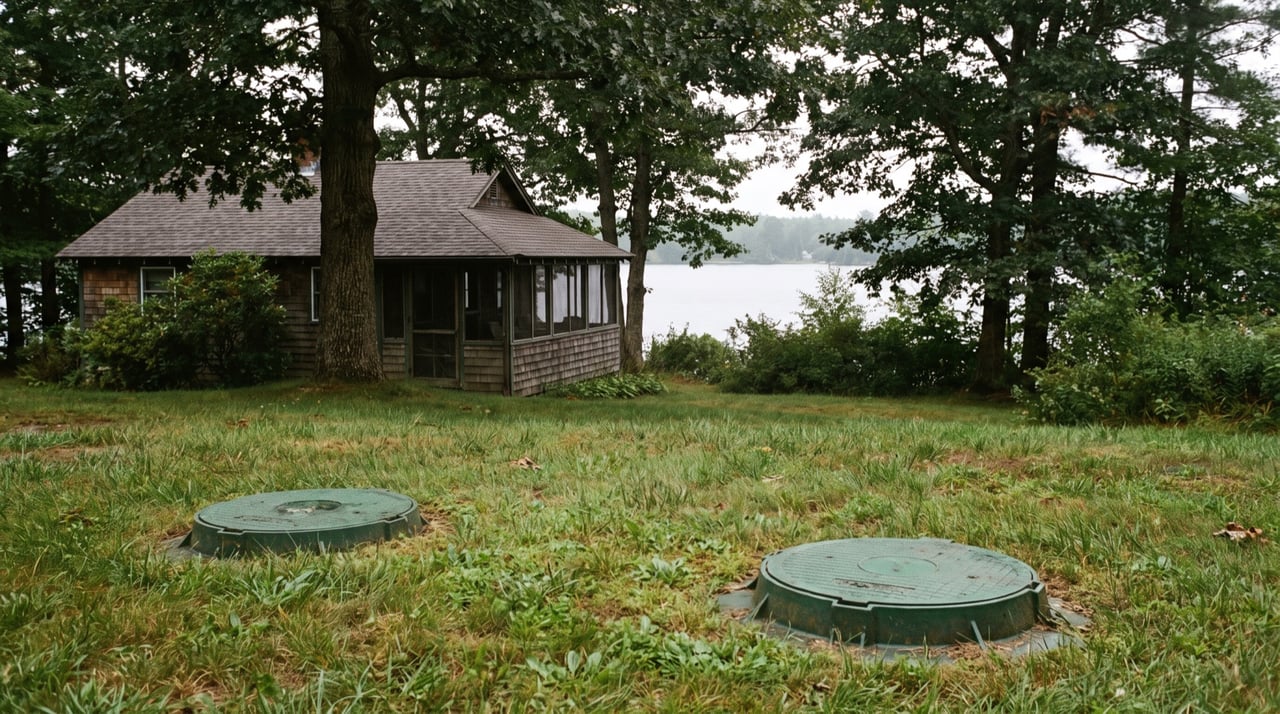
Here is a sentence from the Connecticut Department of Public Health that changes how you should think about the septic inspection on a lake house.
"The State of Connecticut does not certify septic system inspectors nor are there mandatory inspection procedures that all inspectors should follow."
Read that twice. Not only is there no license for the person crawling around your tank, there is no required method. Two inspectors can look at the same system, do completely different work, and both hand you a report.
Why this matters more on the lake than anywhere else
Most of the Candlewood shoreline is on private septic, and on either a private well or a small community water system. That second part surprises people: several of the larger lake associations run their own regulated community water systems, including Candlewood Shores, Candlewood Knolls, Candlewood Trails, Candlewood Springs and Candlewood Orchards. A community system is not a private well. It is a regulated public water system with its own testing, billing and disclosure implications, so establish which one you are buying into. There is no municipal sewer to fall back on, so the system in the ground is the whole answer for a property, and it was often installed for a house that no longer exists in the same form.
A large share of lake housing started as summer cottages. Many have been winterized and converted to year round use over the decades. A septic system sized for a two bedroom cottage occupied eight weekends a year is a different system from one sized for a family living there in February, and the tank does not know the house was renovated.
That is the specific risk on this lake: not a failed system, but an adequate system for a use that ended twenty years ago.
The form almost nobody asks for
Because the state sets no procedure, the Connecticut Environmental Health Association pulled together a committee to create one. According to DPH, that committee included state and local health personnel, septic system installers and cleaners who perform inspections, home inspectors, and members of the Connecticut Association of Realtors.
What they produced is called the Connecticut Recommended Minimum Existing Septic System Inspection Report.
DPH's guidance to buyers about it is unusually direct:
"Prospective buyers should ask their real estate agent and/or their septic system inspector whether or not this form will be used. If the form will not be utilized, you may want to inquire as to the thoroughness of the inspection."
That is the state telling you, in writing, to ask your agent a specific question. In practice almost no buyer asks it, and a fair number of agents have never been asked.
DPH also notes that a supplement with general information about the inspection process and a glossary of septic terms was prepared, and that it should be supplied along with the completed form. If you receive a report with no supplement and no glossary, that tells you something about which standard was used.
What to actually do
Ask the question the state tells you to ask. Before the inspection is booked, ask whether the Connecticut Recommended Minimum Existing Septic System Inspection Report will be used. If the answer is no, ask what will be used instead and why.
Separate the inspection from the pump out. A tank that was pumped the morning of the inspection looks healthy regardless of what the leach field is doing. Ask when it was last pumped and by whom, and be wary of a pump out scheduled immediately before your visit.
Ask what the system was designed for, not what it is. Bedroom count at time of installation is the number that matters, and it should be in the local health file for the property. If the house has more bedrooms today than the system was designed for, that gap is yours after closing.
Go to the town, not just the seller. Septic records live with the local health authority. Connecticut administers this through 59 local agencies rather than a single state office, and those agencies are a mix: some towns run their own municipal health department and others belong to a multi town health district. Around Candlewood you will meet both, so ask for the town health department first and let them point you to a district if that is how their town is set up. Either way the file on a specific property sits locally. That file is where the design, the permits and any repair history live.
Treat well and septic as two separate questions. They get discussed together and inspected separately, and on the lake they often sit closer together than anyone would design today. I wrote separately about why nobody is required to test the well before you buy, and the same theme runs through both: the protections buyers assume exist mostly do not.
What I am not going to tell you
I am not going to quote a price for a septic inspection, a pump out or a replacement system, because those vary enormously by system type, access, soil and district. Get real numbers from a local installer on the specific property.
I am also not going to tell you what your town requires. Connecticut runs this through 59 local health departments and districts, and requirements, fees and timelines differ between them. Call the health department or district for the town the property is in before you are under contract. The conversation is free and it is the fastest way to find out what actually applies.
The code behind the inspection question, in the state's words
The Department of Public Health's subsurface sewage page states the framework in one sentence: "Septic systems, defined as subsurface sewage disposal systems, are regulated by Sections 19-13-B100a and 19-13-B103 of the Regulations of Connecticut State Agencies and the associated Technical Standards for Subsurface Sewage Disposal Systems," and "septic systems on sites with design flows of 10,000 gallons per day (gpd) and less are permitted by the Local Director of Health." That is why the records live at the town or district, not in Hartford.
Section 19-13-B100a is the one written for exactly the cottage-to-year-round history described above. It defines "building conversion" as "the act of winterizing a seasonal use building into year round use by providing one or more of the following: (A) a positive heating supply to the converted area; or, (B) a potable water supply which is protected from freezing; or, (C) energy conservation in the form of insulation to protect from heat loss," and "change in use" as any change "such that, when the building is fully utilized, the design flow or required effective leaching area will increase." Its operative rule: "If public sewers are not available, no building or part thereof shall be altered so as to enable its continuous occupancy by performing any building conversion, nor shall there be a change in use unless the local director of health has determined that after the conversion or change in use, a code-complying area exists on the lot for installation of a subsurface sewage disposal system." The determination "shall be based upon analysis of existing soil data. If soil data is not available, the property owner shall perform soil testing," and the director "may require expansion of the existing sewage disposal system or installation of a new sewage disposal system at the time of the change in use" when the change "results in a more than 50% increase in the design flow." The same section applies the code-complying-area test to building additions, and DPH's explanatory page says the test is required "even if the proposed construction is for a none water use structure," naming a non-bedroom addition, a detached garage or shed, a deck and an in-ground pool as examples, because "whenever a portion of the property will be lost" to a structure, "a code complying area must be found, exclusive of the proposed construction area, prior to an approval being granted."
Section 19-13-B103 governs the system itself. Its minimum requirements section says "each subsurface sewage disposal system shall be constructed, repaired, altered or extended pursuant to the requirements of this section unless an exception is granted," an exception the local director may grant for a repair, alteration or extension "upon a finding that such an exception is unlikely to cause a nuisance or health hazard," but not from the separation distance and Technical Standard requirements that carve-out names. An approval to construct "shall be valid for a period of one year"; each system "shall be constructed by a person licensed pursuant to section 20-341 of the General Statutes"; and "no permit to discharge shall be issued until all required forms are completed and an approved as-built plan or record drawing is received," with a copy of the permit sent to the building official and records of applications, inspection forms and as-built plans kept by the local director of health. That as-built plan and permit to discharge are the two documents to ask the health department for on a lake house, because they tell you what the system was built and approved to serve, which no inspection form can.
Sources: Connecticut DPH, Subsurface Sewage in Connecticut page and "19-13-B100a of the Public Health Code" page (with the section text), and the Public Health Code sections 19-13-B103a through 19-13-B103f as published by DPH (PDF, current through the Connecticut Law Journal of June 1, 2006), all read September 4, 2026. Quoted as published; the Technical Standards and local health district practice change, so confirm with the health authority for the town.
Common questions about septic inspections in Connecticut
Does Connecticut require a septic inspection before a home sale?
There is no statewide requirement, and this is where buyers get caught. The Department of Public Health states plainly that "the State of Connecticut does not certify septic system inspectors nor are there mandatory inspection procedures that all inspectors should follow." Septic is administered through local health districts rather than one state office, so what applies to a specific property depends on the town it sits in. A septic inspection usually happens because a buyer or a lender asked for one, not because the law produced it.
What is the Connecticut Recommended Minimum Existing Septic System Inspection Report?
It is a standard inspection form developed by a committee organized by the Connecticut Environmental Health Association, which according to DPH included state and local health personnel, septic system installers and cleaners who perform inspections, home inspectors, and members of the Connecticut Association of Realtors. It exists precisely because the state sets no mandatory procedure. DPH's own advice is that prospective buyers should ask their agent or inspector whether the form will be used, and if it will not be, to inquire as to the thoroughness of the inspection.
Is a septic inspection part of a normal home inspection?
Usually it is folded in, and that is the problem. DPH notes that when a home is served by a septic system it "usually is inspected as part of the total home inspection process." A general home inspector looking at a septic system as one line item among many is doing something different from a septic specialist opening the tank and evaluating the leach field. Ask which one you are getting.
Why is septic a bigger question on Candlewood than elsewhere?
Because most of the shoreline is on private septic and private well with no municipal sewer, and because a large share of lake housing began as seasonal cottages that were later winterized. A system sized for occasional summer use is not a system sized for year round occupancy, and the conversion of the house does not automatically upgrade what is in the ground. On the lake, the question is rarely whether the system works today. It is what it was designed to carry.
What should I ask for before making an offer?
The design bedroom count from the local health district file, the date and provider of the last pump out, whether the recommended state form will be used for the inspection, and any permit or repair history on record. Get those four before you are emotionally committed to the house. Everything on that list is either public record or a question someone can answer in a sentence, and all of it is cheaper to learn before the offer than after the closing.
Related reading: what the Candlewood Lake Authority asks of a lakefront owner, nobody has to test the well before you buy a lake house, the Candlewood Lake real estate guide, and why your purchase price does not become your assessment.
More on this area: Candlewood Lake waterfront overview.
If you are buying on Candlewood and want the well, septic and shoreline questions handled properly before they become expensive, start at ConnorCTHomes.com.
Connor Kostyra, Licensed Real Estate Salesperson, CT Lic. RES.0836348.
Connor CT Homes is a marketing brand. Real estate services are provided through RE/MAX Rise, 1297 Main Street, Watertown, CT 06795.
This article is general information, not legal, engineering or environmental advice. Septic requirements are administered by local health districts and differ by town. Confirm what applies to a specific property with the local health district and the Connecticut Department of Public Health.