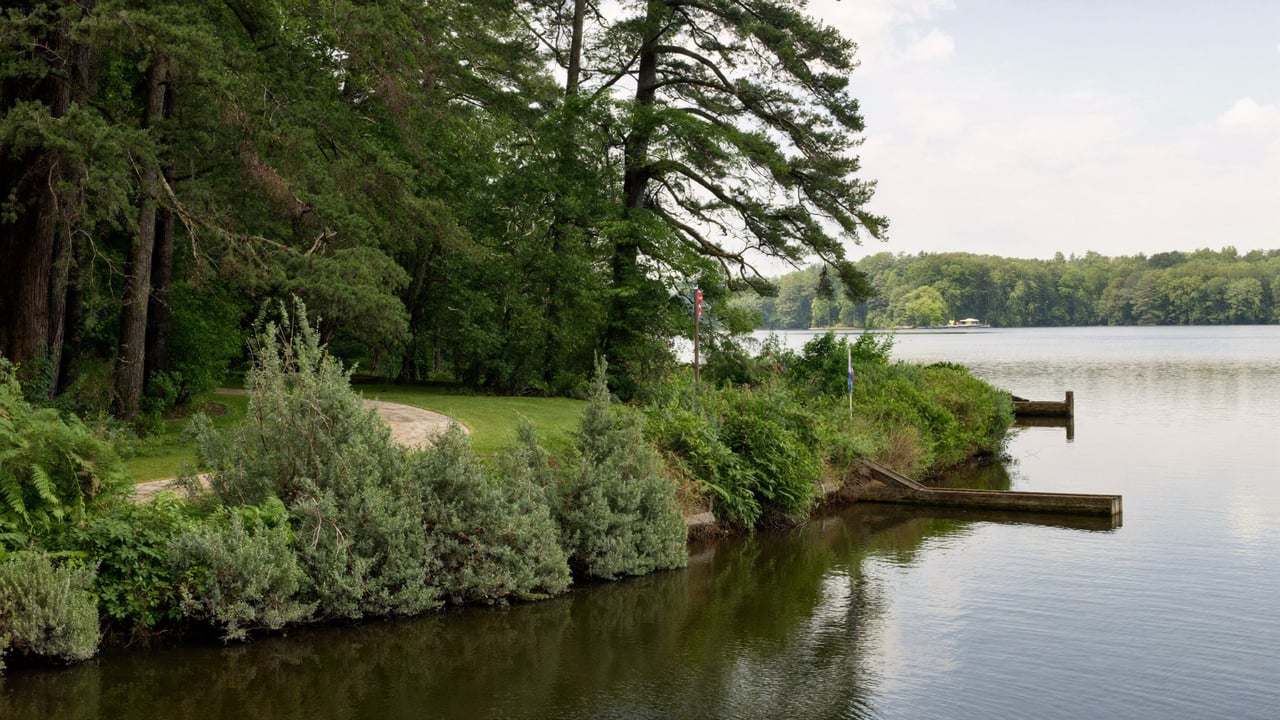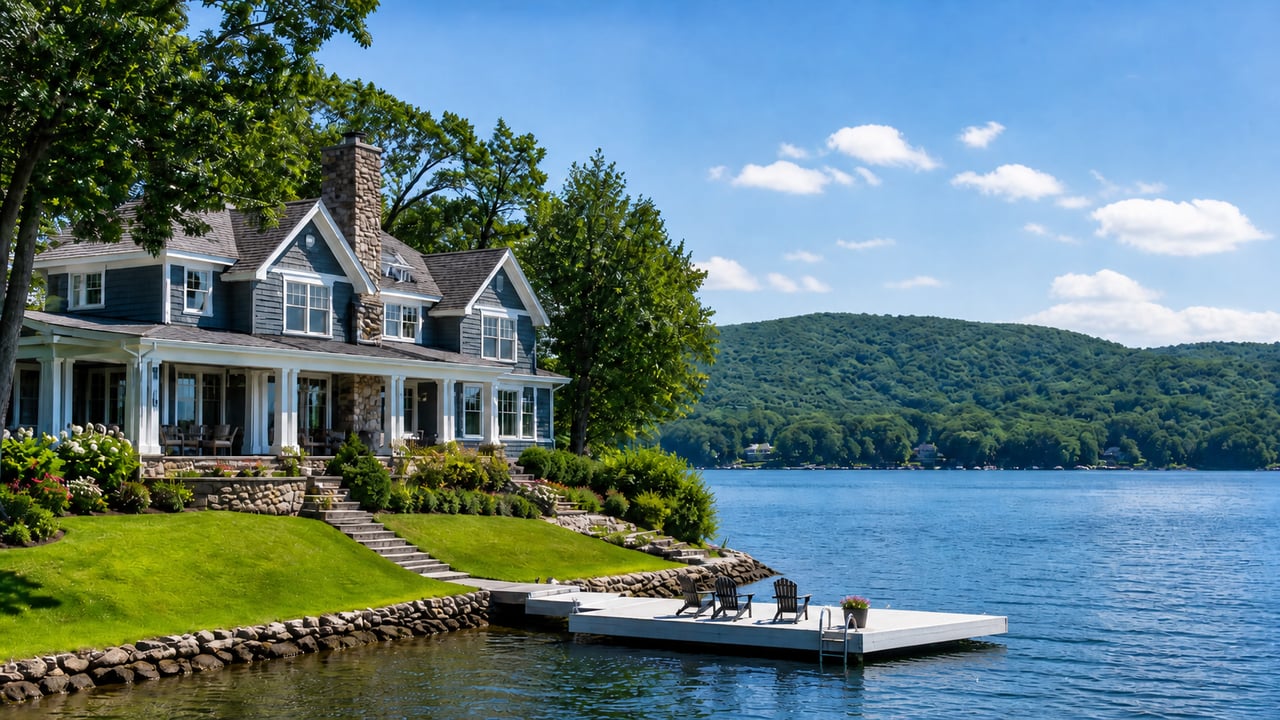
Buying around Candlewood Lake is not the same as buying anywhere else in Connecticut. The lake is private, regulated, and shared by five towns that each treat the water differently. If you're starting your search, this guide is what I tell every buyer before they make their first offer: what makes a property “lakefront,” who controls the dock you saw in the photo, and the questions that quietly cost people deals.
The five towns on Candlewood Lake
Candlewood is a 5,420-acre private lake shared by five Connecticut towns. The same dollar buys different things depending on which side of the water you're on, so most lake searches start by narrowing the town as much as the property type.
New Fairfield
The west shore. The largest amount of Candlewood shoreline of any town. West shore parcels look east across the water, so they get morning sun on the dock. Mostly residential, with established lake associations and pockets of newer construction. Town offices handle building permits and zoning; the Candlewood Lake Authority handles anything that touches the water itself. More on the New Fairfield lake life here, or compare the waterfront neighborhoods in New Fairfield.
Sherman
The north end. Smaller, quieter, with the longest stretch of undeveloped shoreline. The deepest water is not here: the Candlewood Lake Authority puts the maximum depth at roughly 85 feet, in New Milford near the dam, against a lake average of 29.3 feet. Town services are smaller-scale than the south-end towns. If “private and tucked away” is what you mean by lake life, Sherman is the search.
New Milford
The east shore, north of Brookfield. Mix of long-tenured year-round residences and shoreline neighborhoods. East shore parcels look west across the water, which is the sunset side. Larger town footprint than New Fairfield or Sherman, so services and commercial amenities are closer. New Milford also includes Candlewood Mountain and significant land away from the water.
Brookfield
South-end. Smaller share of shoreline, but commuter-friendly to I-84 and a faster drive to Danbury, Stamford, and the Metro-North line at Brewster. Lake-access pockets often trade some shoreline for proximity.
Danbury
Southernmost shore. Several association communities, plus the Candlewood Yacht Club and the town park shorefront. Candlewood Lake Club, despite the name, is not in Danbury: it straddles the Brookfield and New Milford line. Bigger municipal footprint than the lake towns to the north, with commercial, retail, and the only city-style services in the immediate area. It is also the only lake town with its own Metro-North station, though most Danbury Branch trains do not run through to Grand Central, which is worth understanding before you buy on the commute.
Mill rates and town services change every year. Always pull the current mill rate from the town's official website (or ask me to get it for you). Don't price an offer using a rate from someone's old listing description.
What “waterfront” actually means
“Waterfront” on a Candlewood listing can mean any of four very different things. Knowing which one you're looking at is the difference between a fair offer and an expensive surprise.
- Direct waterfront. The property line touches the water. You typically have your own dock (permitted) or dock rights, and you can walk from the house to the lake without crossing anyone else's property. Highest entry price, most restrictive dock and shoreline rules.
- Dock rights / association lake access. The home isn't on the water, but the deed conveys a slip, mooring, or use of an association dock. Look for the rights to be deeded in writing, not assumed because “the neighborhood has access.”
- Lake community / beach association. The neighborhood collectively owns a beach, marina, boat ramp, or community dock. You pay association dues and use it as a member.
- Walk-to-lake / proximity-only. Close to the lake, but no formal lake rights. Nice quality of life, no shoreline access guaranteed.
Picking the wrong category is the most common mistake first-time lake buyers make. The long form is the four kinds of Candlewood waterfront, which maps the listing terms to each category, and two pieces go deeper on it: who actually owns the shoreline explains why even direct waterfront usually stops at the Project Boundary, and the same price can buy two very different lakes shows what the categories do to price in one town.
Docks, shoreline, and lake regulation
Candlewood is a private lake operated by FirstLight Power, the utility that owns the dam and uses the lake for hydroelectric storage. The Candlewood Lake Authority (CLA) is the inter-municipal body that handles environmental management, public safety, and lake-wide policy across the five towns.
What that means for buyers:
- Docks are permitted, not assumed. A dock you see in a listing photo isn't yours until you hold your own permit for it. Ask the listing agent for the FirstLight dock permit number and confirm the dock is authorized today. Do not ask whether the permit transfers, because it does not. FirstLight permits do not transfer when the property changes hands and a new owner must apply for their own, which I set out in your Candlewood dock permit does not come with the house.
- Shoreline modifications are restricted. Adding a dock, replacing an old one, building a seawall, removing a tree near the waterline, all governed by FirstLight rules and (depending on the work) town wetlands review.
- There are watercraft restrictions you should know about. Connecticut tied boating-under-the-influence and motor vehicle DUI penalties together under Public Act 25-159, effective October 1, 2025, so a conviction on the water can reach your driver license. See my piece on what Connecticut's new BUI law means for boaters. Candlewood-specific rules include zones for no-wake, swim areas, and certain hours of operation. The CLA publishes the current rules on their site.
- Annual drawdown. Every year FirstLight lowers the lake by several feet for shoreline maintenance and to control invasive plants. The shoreline you tour in August is not the shoreline you walk in February. Lake elevation matters when you're evaluating dock depth, swim area usability, and seawall condition.
If a dock photo is the reason you're interested in a property, ask three questions: Is the dock permitted? What is involved in obtaining my own permit after closing, given that FirstLight permits do not transfer? What's the water depth at low pool? A “yes” on the first, a realistic answer on the second and an honest answer on the third is the green light.
Year-round vs. seasonal construction
A lot of Candlewood housing started life as a summer cottage. Some has been winterized; some hasn't. The MLS doesn't always make this clear in the listing, so look for the structural tells before you fall in love.
- Foundation. Full basement or slab on grade is usually year-round. Crawlspace with no insulation, exposed plumbing, or a “summer water” disclosure means seasonal.
- Plumbing. Look for insulated piping, heat trace, and a service connection sized for a year-round household. Seasonal cottages often have plumbing that's drained every fall.
- Heating. Forced-air with ductwork or hydronic baseboard implies year-round use. Window units and a wood stove imply seasonal.
- Septic and well. Most of the lake is on private septic and well. Year-round homes need septic systems sized for full-time occupancy and wells with reliable yield. Get the septic inspected and pump-tested, and know that Connecticut does not license or certify septic inspectors. Get the well flow-tested.
- Insulation and windows. Single-pane windows and minimal wall insulation are giveaways for an unconverted cottage.
A seasonal cottage is not a problem if you're buying it to use seasonally. It IS a problem if you're paying year-round prices for one. The difference can be six figures of conversion work.
Septic, well, propane, internet: the lake utilities reality
Almost every lake property has a private septic system, a private well, and propane or oil heat. There's typically no public sewer or natural gas at the shoreline. Plan for:
- Septic inspections at every offer. This is non-negotiable.
- Well flow and water quality testing covering yield, bacteria, arsenic, uranium, and radon-in-water are common Connecticut tests.
- Propane or fuel oil supply contracts to be transferred at closing.
- Internet. Real lake-life issue. Some shoreline pockets get reliable cable; others rely on fixed wireless or Starlink. Ask the seller's agent which provider the home actually uses and what speeds they get. A home with no usable internet is unmarketable to a remote-work buyer.
Insurance considerations
Lake properties run into a few insurance wrinkles inland properties don't:
- Flood zone. Some lakefront parcels sit in FEMA flood zones; some don't. Pull the FEMA flood map for the address before you offer. The zone tells you whether coverage is required, not what it will cost: since FEMA moved to Risk Rating 2.0, premiums are priced on the specific property rather than the zone it sits in.
- Wind/coastal. Most Candlewood properties are far enough inland to be on standard policies, but the carrier may treat older lake homes differently.
- Dock coverage. Confirm whether docks, shoreline structures, and watercraft are covered by the home policy or require separate riders.
I always recommend buyers get an insurance quote before going under contract, not after. If you're considering selling instead, our home valuation tool gives a quick snapshot of what your lake property might be worth in today's market.
The questions that save deals
In order, these are the questions I push every buyer to ask before making an offer on a Candlewood property:
- Is the dock permitted, registered with FirstLight, and what will it take for me to obtain my own permit after closing?
- What category of waterfront is this: direct, dock rights, association, or proximity?
- Is the property year-round or seasonally constructed? Has it been winterized?
- Septic age, last pump, and last inspection?
- Well yield (gallons per minute) and most recent water quality test?
- Internet provider and actual speeds?
- Is the property in a FEMA flood zone?
- Are there association dues, beach rights, or shared facilities, and what are the bylaws?
- What does the property look like at low pool (winter drawdown)?
- Any open building, wetlands, or zoning permits on file?
If the listing agent can't answer half of these confidently, that's information too.
What it costs once you own it
The purchase price is the part you can look up. The column underneath it is where this lake differs from an inland house: property tax and, on some properties, a second mill rate from a special tax district; a dock permit that is a recurring obligation rather than a fixture; septic and water where Connecticut certifies nobody; flood coverage now rated on your specific property; the boat stack; and the exit, where a second home does not get the home sale exclusion. What it actually costs to own a Candlewood lake house works through each with the rule behind it.
If you are on the other side of that and wondering what your own place is worth, what is my Candlewood lake house worth explains why price per square foot fails here and what to use instead.
What the buying process looks like on the lake
The Connecticut purchase process (pre-approval, offer, attorney review, inspection, mortgage, closing) is the same on the lake as anywhere else, though in Connecticut the closing itself must be conducted by a licensed attorney. The lake-specific layers slot in:
- Inspection should include septic (separate inspector), well (separate test), and ideally a dock/shoreline review if there's any structural concern.
- If you're buying with a mortgage, your lender will care about flood zone designation and the home's year-round status. A cottage that is not winterized may also not finance as a second home at all, which is a financing question, not an inspection one.
- If a property is in an association, you'll need the bylaws, financials, and any specific lake-rights documentation as part of due diligence.
The real edge in a competitive lake market is moving fast on the right properties and not at all on the wrong ones. Most of what I do for buyers is the latter, telling them which deals to walk from before they get attached. If you want a sense of what's actually moving, see what's currently on the market.
Want a real read on a Candlewood property?
If you're weighing a Candlewood purchase and want a real read on the property, the town, and what to ask, reply to my newsletter or text me at 203-297-8084. No pitch, no script, just an honest take on whether the property is what the listing says it is.
By Connor Scott Kostyra
Licensed Real Estate Salesperson | License # RES.0836348
RE/MAX Rise Real Estate · 1297 Main Street, Watertown, CT 06795
203-297-8084 · [email protected] · connorcthomes.com
Equal Housing Opportunity. Information deemed reliable but not guaranteed. Nothing in this article is a guarantee of value, appreciation, investment return, or any specific outcome on any specific property.
This guide is the overview. If you would rather go straight to the specific question you came with, every piece on this site is grouped by topic in every Candlewood Lake guide on this site, by question.
Common questions about buying on Candlewood Lake
What does waterfront actually mean on a Candlewood listing?
Four quite different things, and picking the wrong category is the most common mistake first time lake buyers make. Direct waterfront means the property line touches the water, you typically have your own permitted dock or dock rights, and you can reach the lake without crossing anyone else's land. Dock rights or association lake access means the home is not on the water but the deed conveys a slip, mooring or use of an association dock, and those rights need to be deeded in writing rather than assumed because the neighborhood has access. Lake community or beach association means the neighborhood collectively owns a beach, marina, ramp or dock and you pay dues to use it. Walk to lake or proximity only means no formal lake rights at all.
Which of the five towns should I be looking in?
Candlewood is a 5,420 acre private lake shared by New Fairfield, Sherman, New Milford, Brookfield and Danbury, and the same dollar buys different things depending on which side of the water you are on. New Fairfield is the west shore and holds the largest amount of shoreline of any town. Sherman is the north end, smaller and quieter, with the longest undeveloped stretch of shoreline. The deepest water is actually in New Milford, roughly 85 feet near the dam. New Milford is the east shore, north of Brookfield, with a larger town footprint and closer commercial amenities. Brookfield trades some shoreline for I-84 access and a faster drive to Danbury and the Metro North line at Brewster. Danbury is the southernmost shore with city style services.
Is the dock in the listing photos actually mine when I buy?
No, and this is worth being precise about. Docks on Candlewood are permitted, not assumed. FirstLight issues the permit to the owner rather than to the property, and its own application materials require the new owner to file their own Existing Use Permit and to produce the deed confirming the change in ownership before that application can be completed. So the useful questions are whether the existing structure is properly authorized, and what the water depth is at low pool.
How do I tell a seasonal cottage from a year round house?
A lot of Candlewood housing started life as a summer cottage, and the MLS does not always make it clear. Look for the structural tells. Foundation: full basement or slab on grade is usually year round, while an uninsulated crawlspace, exposed plumbing or a summer water disclosure means seasonal. Plumbing: insulated piping and heat trace versus plumbing that gets drained every fall. Heating: ducted forced air or hydronic baseboard versus window units and a wood stove. Insulation and windows: single pane glass and minimal wall insulation give away an unconverted cottage. A seasonal cottage is not a problem if you are buying it to use seasonally. It is a problem if you are paying year round prices for one, and the difference can be six figures of conversion work.
What does the shoreline look like in winter?
Different, and buyers touring in summer routinely miss this. Every year FirstLight lowers the lake by several feet for shoreline maintenance and to control invasive plants. The shoreline you tour in August is not the shoreline you walk in February, and lake elevation matters a great deal when you are evaluating a dock. If you are looking at a property in season, ask what the same frontage looks like at low pool before you decide what the dock is worth to you.