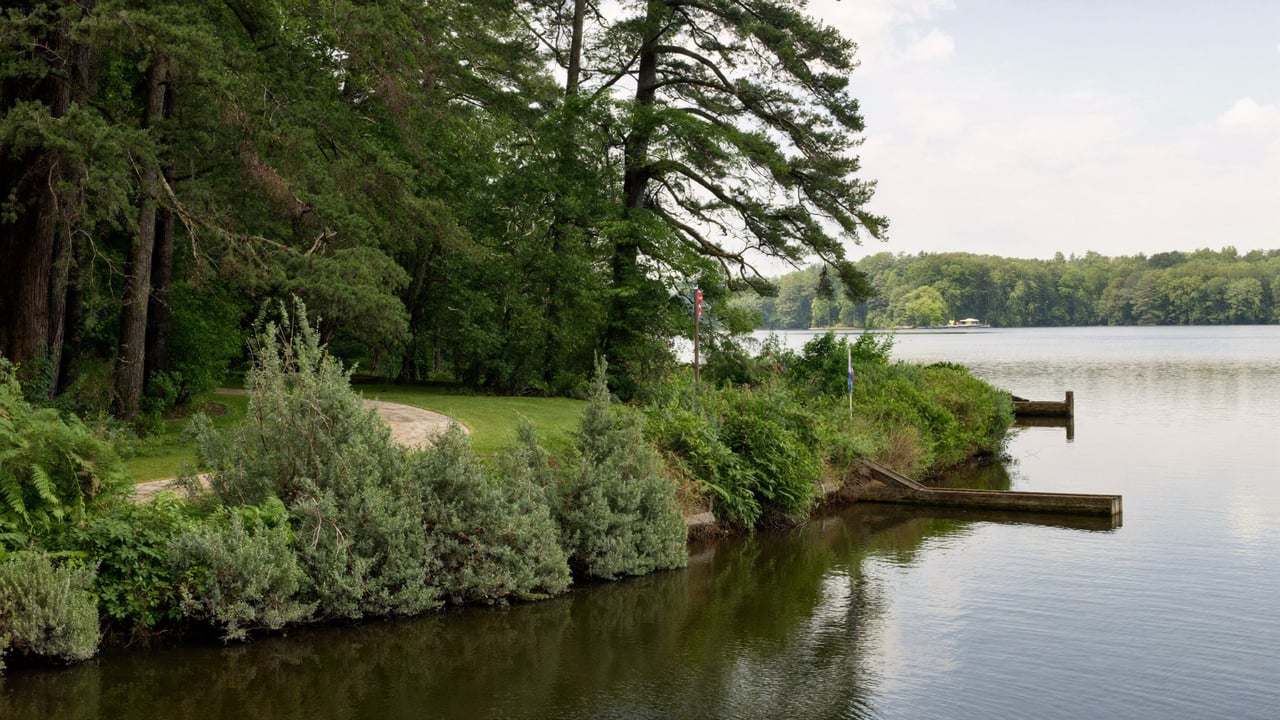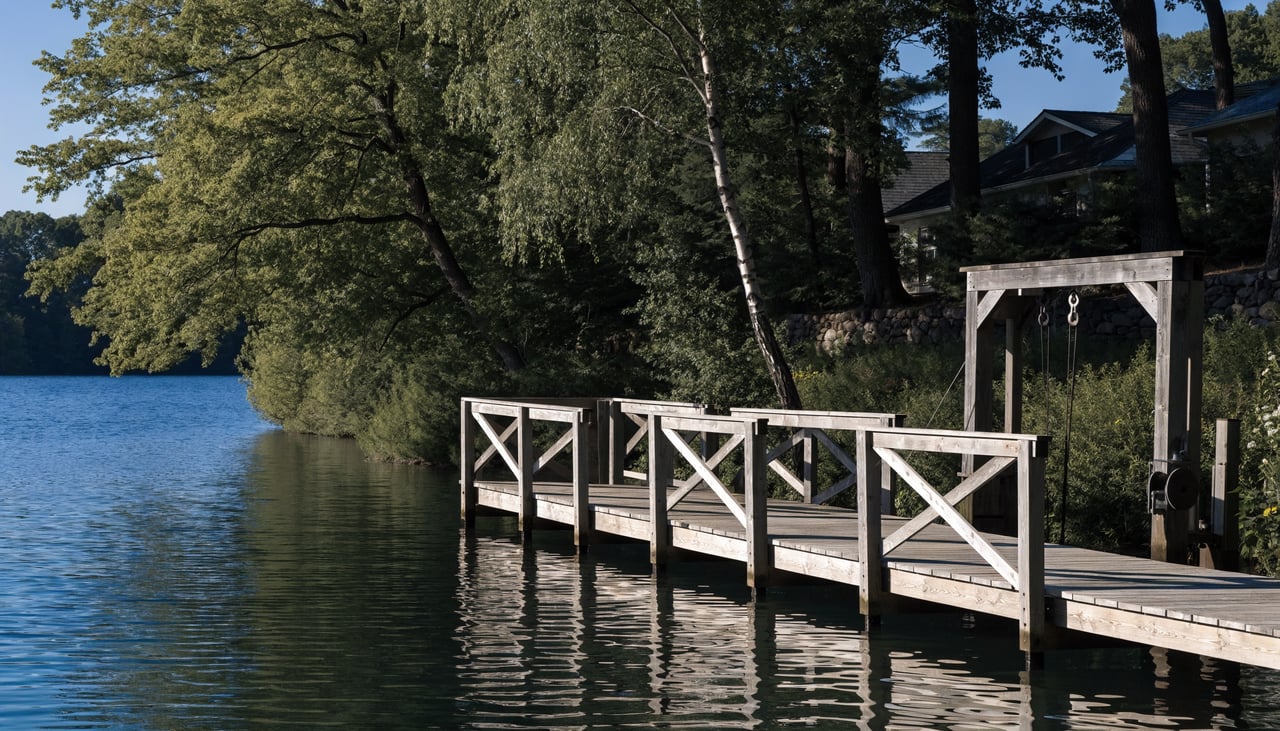
Almost every buyer I take out on Candlewood asks some version of the same question. Can I put a dock in, or fix the one that is already there?
The answer surprises people, and the part that surprises them most is not about building anything. It is that the permit on the dock you are looking at does not come with the house.
The dock is not just yours to decide about
Candlewood is not a natural lake. It is the upper reservoir of a pumped storage plant, operated by FirstLight Power under a federal license, and the shoreline sits inside what the license calls the Project Boundary.
FirstLight's approved Shoreline Management Plan puts it in one sentence: "All docks on Project waters require authorization from FirstLight."
It does not stop at docks. The same plan requires authorization for shoreline and land uses inside the boundary including boat lifts, seawalls, ramps to the water, rip rap, jetties, retaining walls and paths. And it covers more than new construction. Repairing an existing use, modifying an existing use, or installing a new one all require authorization.
Owning the land does not get you out of it
This is the one that costs people money.
FirstLight's own permit application FAQ asks the question directly: "If I own the land, do I still need to apply for a Permit?" The answer is: "Yes. If the land is within FirstLight's federal Project Boundary, it is subject to FirstLight's permit requirements."
Inside that boundary FirstLight either owns land outright or holds flowage rights over it, and its federal license obliges it to review uses that could affect the project. Ownership of the dirt is not the deciding factor. Location relative to the boundary is.
Where the boundary actually runs, and the shortcut that gets people in trouble
You will hear the Project Boundary described as the 440 foot line. Do not plan anything around that number.
The Candlewood Lake Authority is explicit that the boundary "does not follow the 440' elevation line in all areas" and that "you need to have a land survey done to officially locate the Rocky River Project Boundary." The figure 440 does not appear anywhere in FirstLight's approved plan.
So the honest answer to "is my dock inside the boundary" is that a Connecticut licensed surveyor tells you, and a topographic contour on a map does not. That is not me being cautious. It is the lake authority's own instruction.
The permit does not transfer when the property sells
Here is the part that belongs in every Candlewood transaction and shows up in almost none.
FirstLight's approved Shoreline Management Plan states it outright: "The permit does not transfer upon sale of the property and new property owners must apply. This permit application process can be started prior to purchase as part of FirstLight's pre-purchase inspection program." A buyer does not inherit the seller's authorization, and the application is the buyer's to file.
Two finer points get repeated wrongly around this lake. A Certificate of Permission is not the same instrument as a permit, and the plan is specific that certificates "are not transferrable and new property owners must apply for an Existing Use Permit." And short term authorizations are not absolutely frozen. An activity permit, the plan says, "is only transferred at FirstLight's discretion," which is a narrower and more accurate statement than the flat "nothing transfers" you will hear at a dock party.
A buyer can start before closing. FirstLight's checklist states that "for abutting properties in a pending sale, the potential purchaser may start their Existing Use Permit Application prior to purchase." It then draws the limit plainly: "By submitting the application prior to purchase, your application is automatically considered a Pre-Purchase Inspection Request. You will not be issued a permit prior to purchase."
So what a buyer can obtain before closing is an inspection, not a permit. Once FirstLight inspects the lands and waters inside the project boundary, it issues a Pre-Purchase Inspection Report, which it describes as a compliance assessment of the inspected shoreline and land uses measured against its own regulations and guidelines. That report is the single most useful document a Candlewood buyer can order, because it is the thing that tells you whether the dock in the listing photos is actually compliant.
The deed finishes the application: "Following purchase, you will need to provide your deed confirming that you are the new owner of the abutting property to complete your application."
Four mechanics worth knowing before you write an offer:
- There are two fees, not one. The application submittal fee is $150.00. An Existing Use Permit Application with Pre-Purchase Inspection carries an application submittal and pre-purchase inspection report fee of $400.00.
- Allow far more time than your contract runs. FirstLight's sheets state a "minimum 75-120 day processing and review time." Most Candlewood contracts do not run that long, which is why this gets started early or not at all.
- On the standard path, the seller starts it. For an ordinary Existing Use Permit the current property owner starts the application, and the applicant then has 30 days to submit all required material. On the pre-purchase path the potential purchaser starts it instead.
- Prove the pending sale, but do not send the contract. FirstLight asks for written confirmation from the current owner or their representative that the buyer is under contract to purchase the property, along with a list of any agents or representatives, and instructs: "Please do not submit a copy of your sales contract."
Read that again as a buyer. The dock in the listing photos can be entirely real, entirely in the water, and entirely permitted for the seller, and none of that carries over to you automatically. You apply for your own.
The pre purchase inspection almost nobody uses
The useful part is that you do not have to wait until closing to find out where you stand.
FirstLight's plan says the permit application "can be started prior to purchase as part of FirstLight's pre-purchase inspection program." A buyer under contract can begin the application, and FirstLight will inspect and report on whether the dock, the wall, the stairs and everything else inside the boundary actually complies.
No permit is issued before you close. What you get is an answer, in writing, from the party who decides, before you own the problem. For a lakefront purchase that is one of the most valuable pieces of diligence available, and it is free of the guesswork that comes from asking a neighbor.
A dock that exists is not the same as a dock that is permitted. Those are different facts and only one of them shows up in photographs.
What about the town, and what about the state
Two things people usually get backwards.
Town zoning largely does not reach inside the boundary. FirstLight's plan states that municipal zoning authorities have no jurisdiction to issue permits or enforce regulations within the Project Boundary, and the Connecticut Supreme Court reached a compatible result in Hackett v. J.L.G. Properties, holding that a structure inside the project area built with the licensee's permission did not require local zoning or building permits, on federal preemption grounds.
But the local inland wetlands lane is expressly preserved. The plan keeps municipal inland wetlands jurisdiction intact, and under Connecticut's Inland Wetlands and Watercourses Act the municipal wetlands agency, not the state, is the licensing authority for regulated activities in each town. So "zoning does not apply" is not the same as "no town approval is needed."
And CT DEEP's dock permit does not apply here. DEEP's Structures, Dredging and Fill program governs tidal, coastal and navigable waters as the statute defines them, which reaches Long Island Sound and its tributaries up to the first permanent obstruction. Candlewood is inland. That permit is not required, and it is not available either. Asking DEEP for a Candlewood dock permit is asking the wrong agency.
What to actually do
If you are buying. Ask, in writing, whether a current FirstLight permit exists for the dock and every other structure below your line, and get a copy. Start the application while you are under contract so the pre purchase inspection happens before you close, not after. Do not accept "it has always been there" as an answer, from anyone.
If you are selling. Find your permit before you list. If the dock, the wall or the stairs were built or altered without authorization, you want to know that on your own schedule rather than during a buyer's diligence, which is the worst possible moment and the most expensive.
If you own and want to build or repair. Start with FirstLight, not with a contractor. Applications go through the shoreline and land use permit portal, and current requirements are at FirstLight's permits page. Then handle the town's inland wetlands agency. In that order, because the party that can say no about the boundary is FirstLight.
One thing to watch
FirstLight has filed a six year update to the Shoreline Management Plan with FERC. As of early September 2026 I could not confirm that FERC has approved it, so the rules described above are the ones in force from the approved plan. I compared the approved plan and the proposed one line by line in what changes in the proposed Candlewood shoreline plan: application fees go up, and engineered design for seawall work moves from discretionary to required. Before you spend money on drawings, confirm current requirements directly with FirstLight rather than relying on this article or any other.
The fees and timelines above are taken from FirstLight's published application information sheets, which carry a January 2022 revision date. Those figures change, and a wrong number is worse than no number, so confirm the current ones with FirstLight before you budget around them rather than relying on this article.
Why this matters more than it sounds
Two Candlewood houses at the same price can be very different purchases, and the dock is often where the difference hides. One has a permitted structure and a clean path to the buyer applying for their own. The other has a dock somebody built in 1994, no paperwork, and a conversation with FirstLight waiting for whoever buys it.
That is not a detail you can see from the water, and it is not in the listing.
Related reading: Candlewood's drawdown, in FirstLight's own words, what the Candlewood Lake Authority asks of a lakefront owner, who actually owns the shoreline on Candlewood Lake, what the 2026 deep drawdown changed, and why the dock in the listing photos may not be part of the sale.
If you are buying or selling on Candlewood and want the dock question answered before it becomes expensive, start at ConnorCTHomes.com.
Update, September 2026: a town is now asking about approved dock usage
Everything on this page turns on what a specific permit approves and what it restricts. The Candlewood Lake Authority's regular meeting minutes for August 12, 2026 show a member town putting that question formally. The chairman's report records that "The Sherman First Selectman requested a meeting to discuss the CLA docks usage in Sherman. We will connect with First Light with regards to the approved usage, restrictions, etc." The second sentence is the one that matters here. Even the Authority, asked about dock usage by one of its own member towns, has to go back to FirstLight to find out what the approved usage and the restrictions actually are. If that is the route for a town, it is the route for a buyer, and it is why the answer never comes from a listing photo or a seller's description. No rule has changed. The minutes set no date and name no outcome, and the document prints that these minutes "are not considered official until they have been approved at the next regularly scheduled meeting of the Candlewood Lake Authority."
Communities that run their own docking handle this more formally, and the paperwork is stricter than most buyers expect. Candlewood Knolls is the clearest published example: a fixed number of slips, residents only, and an annual filing requirement. I set that one out in what a Candlewood Knolls boat slip actually requires.
Connor Kostyra, Licensed Real Estate Salesperson, CT Lic. RES.0836348.
Connor CT Homes is a marketing brand. Real estate services are provided through RE/MAX Rise, 1297 Main Street, Watertown, CT 06795.
This article is general information about a federal and municipal permitting process, not legal advice, and not a substitute for a survey. Requirements change. Confirm current rules directly with FirstLight, your town's inland wetlands agency, and your attorney.