The Candlewood Lake Authority publishes a 24 page guide for the people who own the shoreline, and it opens with the sentence a buyer should read first: "People will pay more to live on a lake with better water quality." The guide, marked "First Edition: Published 2019" and still posted on the Authority's site on September 4, 2026, is written as a list of things an owner can do. Read from the other side of the closing table, it is a list of things a buyer should ask about, because every one of them is either a state law, a permit, a maintenance bill or a landscape decision the last owner already made. Here is what it says, quoted as printed, and what each part means before you write.
Every figure and rule below is from the guide itself, with the one exception noted: the fertilizer law, which the guide summarizes and dates to January 1, 2013.
Why the Authority ties water to price
The guide's first page: "Recent studies, including one done here on Candlewood, have linked water quality with property values on lakes throughout the US from Minnesota to Maine. Lakeshore properties are in demand and the value of these properties depends upon the quality of the lake. People will pay more to live on a lake with better water quality. What you and your neighbors do to protect and improve the water quality of Candlewood Lake will protect your investment in your lakeshore property." It describes the change it is responding to: "Small summer homes have given way to larger year-round homes," and "homes, driveways and fertilized lawns have replaced trees and natural shoreline." The scale it gives for the lake: a watershed of 25,860 acres, "about 5 times as big as the Lake's surface," 54 billion gallons of water, and "a long 3-year retention time," so "water and any pollution that might be in the lake take a long time to flush out."
The one rule that is a state law
Under the heading "Use Phosphorus-Free Fertilizer," the guide says "besides being lake-friendly, it is now the law," and summarizes it: "Since January 1, 2013, Connecticut State law prohibits: the use of phosphorus-containing lawn fertilizer unless you are establishing a new lawn, repairing that lawn, or an approved soil test (within 2 years) shows that your soil requires more phosphorous for lawn growth; the application of lawn fertilizer on impervious surfaces; the application of lawn fertilizer within 20 feet of any surface water," with a 15 foot allowance where a drop spreader, a rotary spreader with a deflector or a targeted spray is used, and "the application of any phosphate-containing lawn fertilizer between December 1 and March 15." The guide notes the law does not apply to agricultural land or golf courses, and tells you how to read the bag: the middle number of the three is phosphate, and "a 'zero' in the middle means it is phosphorus-free." For a lakefront buyer the 20 foot line is the one to picture on the lot, because on most Candlewood parcels it runs through the lawn.
The reason the Authority cares is spelled out with a figure: "1 lb of phosphorus can produce up to 500 pounds of wet algae!" and "urbanized areas account for 28% of Candlewood Lake's watershed but contribute a greater percentage of phosphorus to the Lake."
The permit line, in the guide's own words
Two permit sentences sit inside the landscaping pages. On erosion: "Please contact your municipal wetlands commission to determine if you need a permit before beginning any work on your waterfront property. Have an approved erosion control plan and measures in place with your contractor before you begin." And in capitals on the buffer page: "Planning On Doing Work Along The Lake? If you are doing any work within the Rocky River Project Boundary (formerly the 440' Line) you MUST get a permit first!" That boundary is FirstLight's, and it is the subject of who actually owns the shoreline on Candlewood Lake and your Candlewood dock permit does not come with the house. The guide is the Authority telling homeowners the same thing in a brochure: the strip between the deed and the water is not free to work on.
Septic: the maintenance schedule and the signs of failure
The guide's septic pages are the closest thing on the lake to an inspection checklist. It recommends having the system "inspected every 2-3 years" and pumped "every 3-5 years but this depends on how much your system is used and its size," warns that a failing system "can cost tens of thousands of dollars to repair or replace," and lists the signs: "Pooling water or muddy soil around the tank or leaching area or in your basement," "bad smell coming from leaching area or septic tank," "toilet or sink backs up when you flush or do laundry," and "lush bright green grass over the leaching area." It adds that "due to unsuitable soils, high bedrock or groundwater, or small lot size you may have a hard time making a traditional septic system work on your property," and that alternative systems using sand, peat or plastic media "are regulated by the Connecticut Department of Energy and Environmental Protection." The rules of use it gives, no garbage disposal grinder, no hot tub or pool drained into the tank, no vehicles on the leaching area, are the questions to ask a seller alongside the pumping receipts. Connecticut does not certify the person inspecting your septic covers who actually does that inspection.
The footprint decisions the last owner made
- Impermeable surface. "Keep paved driveways as small as possible," and, on lakeshore lots, "rooftops are impermeable too, so keep your home a modest size and build up, not out, on lakeshore lots, when possible." A gravel driveway, the guide notes, "over time the compaction can make them nearly as impermeable as regular asphalt."
- Lawn. "Studies have found that areas of lawn can create more runoff than similarly sized wooded areas," and the guide's advice is to keep only the lawn you use and "start making it smaller by planting more trees and shrubs around the edges."
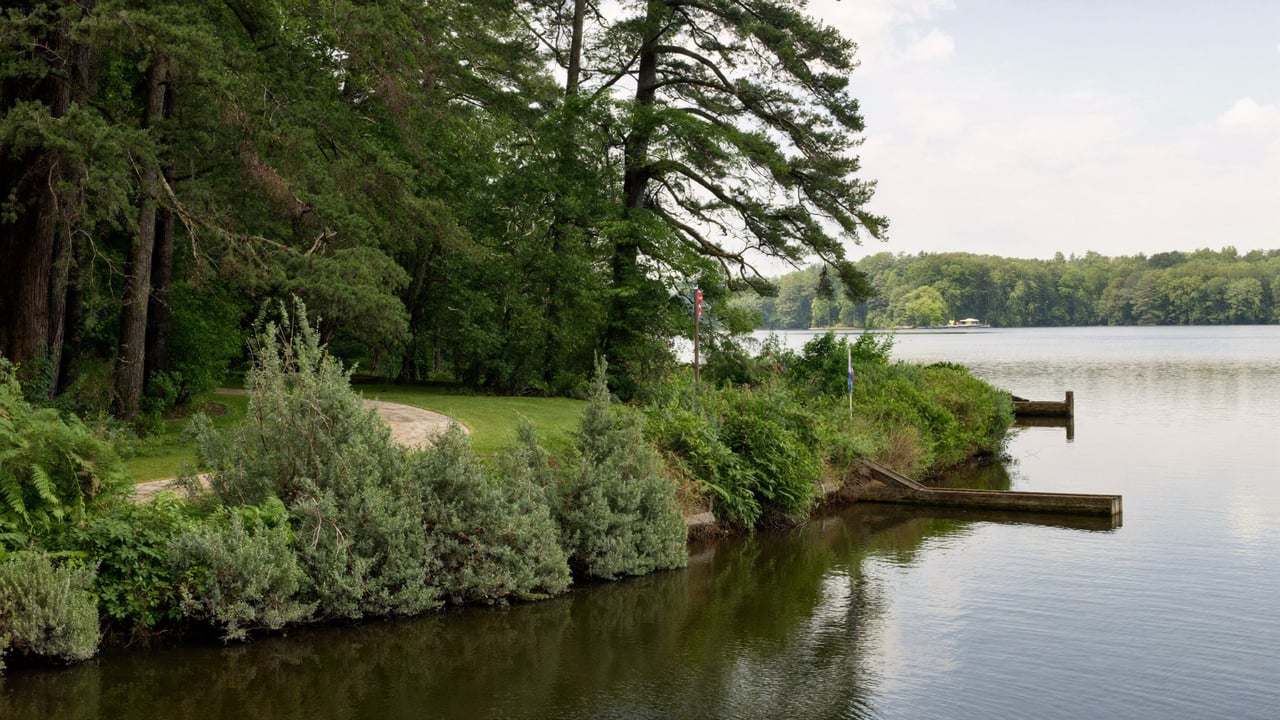
- The buffer. "A vegetative buffer, or buffer zone, is a strip of natural vegetation along the shoreline," and "ideally, the vegetation should cover at least 50-75% of the property's lake frontage." Among the benefits it lists are "privacy from lake users" and geese control: "Canada geese love short, tender grass and avoid tall grass where predators can hide. A shoreline buffer will help send the geese packing." The guide also says a naturally landscaped yard "adds value to your property."
- Rain gardens. A typical one is "around 100-300 sq. ft. and 4-8 inches deep," placed "at least 10 ft. from your home's foundation."
- Plants. Candlewood is "zone 6a of the plant hardiness zones." The guide's "Invaders for Sale" list of plants still sold at nurseries but to avoid includes burning bush, Japanese barberry, Norway maple, English ivy, periwinkle, Callery pear and purple loosestrife; native suggestions run from serviceberry and winterberry to Joe Pye weed and switchgrass.
The household pages
The rest of the guide is what it asks of daily life: fall is the best time to fertilize if you fertilize at all, mow to "2½ - 3 inches," keep leaves and clippings out of the street and storm drains, pick up pet waste, do not flush old drugs, keep car fluids off the driveway, and conserve water because "using less water means less water going through your septic system." It gives one number for scale: "Average indoor water use in a typical single-family home is almost 70 gallons per person per day." Every one of those is a small item; the guide's point is that with a three year retention time they add up in the lake before they show.
What to do with this before you offer
- Ask for the septic history in the guide's terms: the last inspection, the last pumping, the system type, and whether it is an alternative system regulated by the state.
- Walk the 20 foot line. Where fertilizer cannot lawfully go is also where the buffer should be; if the lawn runs to the water, the guide's advice and the law are both telling you what the shoreline will need.
- Read any recent shoreline work against the two permit sentences. Wetlands commission for the waterfront, FirstLight inside the project boundary. Work without either is a question for the seller, not a feature of the listing.
- Treat the footprint as fixed cost. The driveway, roof and lawn the last owner built are the runoff the guide is describing, and changing them later is expensive; buying them is cheaper than rebuilding them.
- Put the guide's price argument to work. The Authority's own first page says buyers pay more for better water. What it actually costs to own a Candlewood lake house and zebra mussels are in Candlewood, hydrilla is not yet carry the rest of that argument.
Common questions about the Candlewood Lake homeowner guide
Is phosphorus lawn fertilizer illegal near Candlewood Lake?
The guide summarizes a Connecticut law in force since January 1, 2013: no phosphorus lawn fertilizer except for a new lawn, a repair, or a soil test within two years showing a need; none on impervious surfaces; none within 20 feet of surface water, or 15 feet with a drop spreader, deflector or targeted spray; and none between December 1 and March 15.
How often should a Candlewood lake house septic system be pumped?
The Authority's guide says inspect every 2 to 3 years and pump every 3 to 5, depending on use and tank size.
How much of the shoreline should be a vegetative buffer?
The guide says the vegetation should ideally cover at least 50 to 75 percent of the property's lake frontage.
Do I need a permit to work on my Candlewood shoreline?
The guide says to contact the municipal wetlands commission before any waterfront work, and that any work within the Rocky River Project Boundary, formerly the 440 foot line, requires a permit first.
How old is the guide?
It is marked "First Edition: Published 2019" and its file was created in February 2019; the Authority still posts it on its website as of September 4, 2026.
Sources: Candlewood Lake Authority, "Candlewood Lake Homeowner's Guide to Lake Friendly Living," 24 pages, First Edition published 2019, PDF created February 28, 2019, downloaded from candlewoodlakeauthority.org on September 4, 2026: pages on water quality and property value, stormwater runoff, impervious surfaces, lawn size, water use, erosion, lawn care, phosphorus, phosphorus free fertilizer and the 2013 law, septic systems, drugs, vehicles, hazardous waste, water conservation, vegetative buffers, rain gardens, native and invasive plants, the Authority and the watershed. The guide credits the Lake George Association for the format.
Related reading: Candlewood Lake water quality in 2025, read for a buyer, nobody has to test the well before you buy a lake house, what changes in the proposed Candlewood shoreline plan and the Candlewood Lake overview.
If a lakefront house is on your list and you want the septic, the shoreline and the permits read against the Authority's own guide before you write, reach me through ConnorCTHomes.com.
Connor Kostyra, Licensed Real Estate Salesperson, CT Lic. RES.0836348.
Connor CT Homes is a marketing brand. Real estate services are provided through RE/MAX Rise, 1297 Main Street, Watertown, CT 06795.
This article is general information, not legal advice. The fertilizer law is summarized as the Candlewood Lake Authority's 2019 guide summarizes it and may have changed since; septic, wetlands and shoreline permit questions belong with the town, the health department and FirstLight. Confirm current rules before relying on anything here.