The Candlewood Lake Authority posts a year end water quality report, and the 2025 edition is the first one a 2026 buyer can read. It is 28 pages, prepared by J. Neil Stalter, the Authority's Director of Ecology, "For the Communities of Brookfield, Danbury, New Fairfield, New Milford, and Sherman," and its PDF was created March 4, 2026. It is not a swim advisory and it does not test beaches for bacteria. It is the chemistry of the open lake, measured monthly at five points from May to October, against a record that goes back to 1983. Here is what it says, quoted as printed, and what each part means if you are about to buy on the water.
Every figure below is from the report itself. Where I convert a unit or add up a table, I say so.
What the report is and how the lake is measured
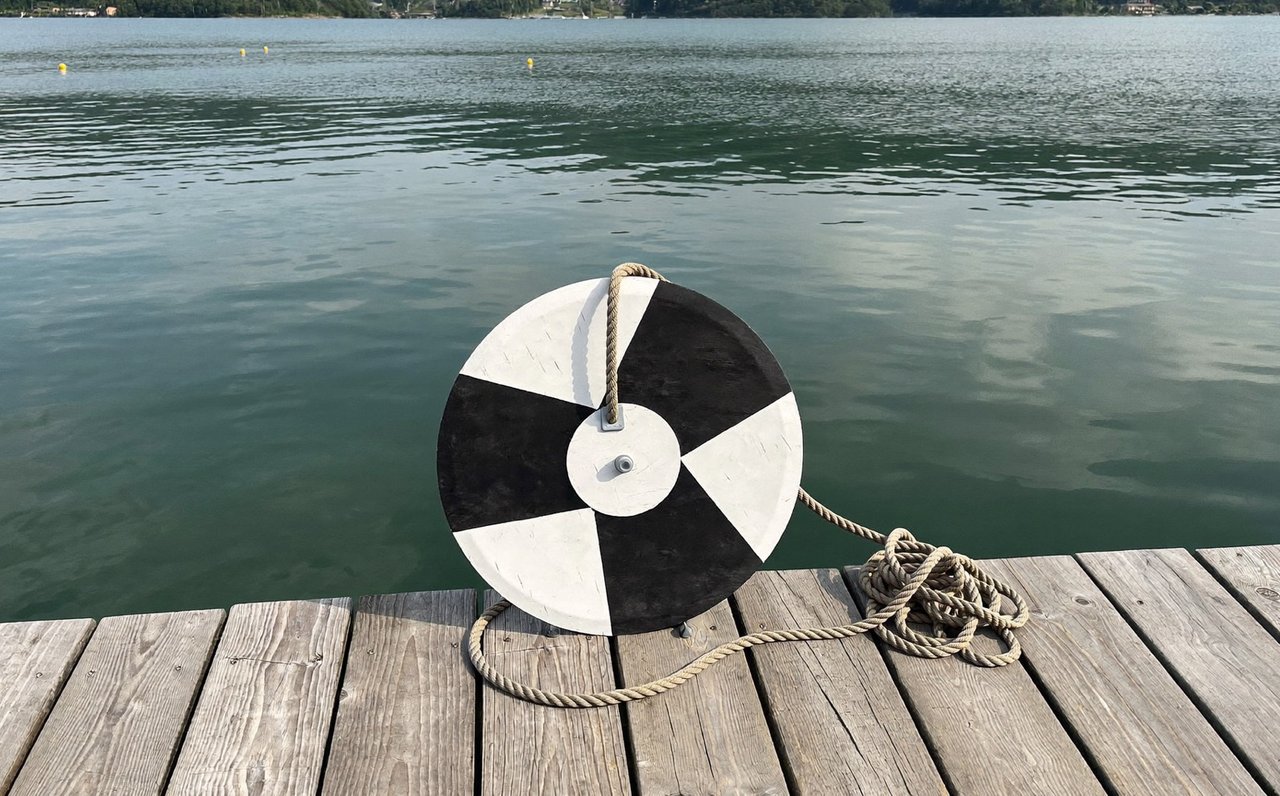
The Authority "began a monitoring program in 1983," has "conducted this monitoring itself since 1998" with the exception of 2017 through 2019, and since 2023 has sent its samples to "the UCONN Center for Environmental Sciences and Engineering's nutrient and metals divisions." It samples "4 sites on Candlewood Lake, and one site on Squantz Pond," named Danbury, New Fairfield, New Milford and Sherman. At each site a probe reads temperature, oxygen, pH, conductivity, cyanobacteria and chlorophyll at one meter intervals, a Secchi disk is lowered until it disappears, and water is drawn from three depths for the lab. The report notes one change: "2025 is the first year where we returned to once monthly sampling after 4 years of twice monthly sampling from May-October."
The report also fixes the scale of the thing you are buying into. "Candlewood Lake is Connecticut's largest, with a surface area of 5,064 acres." The shared Candlewood and Squantz watershed is "approximately 25,907 acres," and "New Fairfield and Sherman contain 73% of the watershed." Since 1970 "the percentage of the watershed classified as urban has increased from 11.7% to 28.3% in 2007." The Authority itself is a creature of the five towns, "formed from ordinances by the municipal governments" under state statute, and the towns "equally share a substantial amount of the responsibility for much of the CLA's operational budget," with FirstLight Power making "a voluntary contribution."
The four numbers a buyer should know
- Clarity. Secchi transparency in 2025 "ranged from a low of 1.65m in New Fairfield in October to a high of 4.08m in New Milford in June. The average reading across the whole of both Candlewood and Squantz was 2.63m, with the highest average being New Milford at 3.01m, and the lowest being Danbury at 2.42m." That average is about eight and a half feet. The report calls 2025 "the third year in a row of roughly similar average secchi transparencies, with 2.67, 2.85, and 2.65 in order. These are all good, and slightly better than Candlewood's comprehensive average of 2.61."
- Phosphorus. "This year continues a general improvement in phosphorus measurements at the epilimnion. There were no readings above 30 μg/L giving an average reading of 17.2 μg/L. For reference, 2023's average was 18.8 μg/L. 2024 was slightly better than this year at 16.5 μg/L." Over the whole record, "the slope representing the average epilimnion phosphorus levels is negative at all 4 sites on Candlewood," which the report calls "very encouraging news," then qualifies: "a very small, modest decrease over a long period of time; a decrease that can be reversed very easily should nutrient pollution in the watershed increase."
- Chlorophyll, the algae measure. The season average was 5.65 micrograms per liter. "The largest measurement taken in 2025 was in Squantz in late July at 10.7 μg/L," and "the highest measurement in Candlewood was in late October at the New Fairfield location, coming in at 9.9 μg/L." The year had "a lack of large scale algae bloom events during the year, with the exception of some in the Danbury/Lattins Cove area in June," and "2025 ranks relatively well compared to past years in both secchi depth and chl-a. It is very similar to 2019, and 2023."
- Conductivity, the salt measure. The long record shows "a pretty clear increase in the water's conductivity," which the report ties to "stormwater runoff and stormwater discharges that empty into the lake." Then: "2025 is now the second consecutive year where this concerning trend has changed a bit, where average numbers decreased. However, we are seeing a general increase from 2024." For scale, "seawater has a conductivity of 50,000 μS/cm, and the limit of drinkable freshwater is around 3000 μS/cm."
The report's own verdict on the whole: "In most categories in 2025, Candlewood remained in a mesotrophic or early mesotrophic condition, after improving in recent years in some metrics from a late mesotrophic condition."
Where the readings differ around the lake
Buyers ask whether one arm of the lake is "cleaner" than another, and the report does not rank neighborhoods. It does print site averages. For clarity, the 2025 Secchi averages were New Milford 3.01 meters, Sherman 2.66, New Fairfield 2.58, Squantz 2.46 and Danbury 2.42. The New Milford site is also the deepest and the one that "sometimes" carries "two separate anoxic zones," which the report links in part to FirstLight pumping: "2023 was also the first year that FirstLight Power, the current owners of the lake, pumped water up into the lake from the Housatonic River at semi-regular intervals during the summer, which continued in 2025." The Authority expects the pumping "will likely increase the lake's ability to mix," and says "this tendency might also be strongest at the New Milford site, which is the closest to the input from the penstock."
Two cautions before you read too much into a site number. Each is one open water station, not a cove, so it says nothing about the water off a particular dock. And the differences are small against the year to year swing: the same New Fairfield station that posted the lowest reading of the year in October posted 3.4 meters in June.
The bloom that came after the season
The part of the report most relevant to a fall closing is the section the monitoring calendar would normally miss. "The late fall and early winter in Candlewood Lake in 2025 was marked by a significant persistent and large scale bloom event" that affected "primarily the main basin" in New Fairfield "and spread northward into the Sherman arm of the lake." The Authority sampled the blooming water on November 24, 2025 at four points, and "as expected, these represented the highest nutrient concentrations taken all year for both nitrogen and phosphorus." The mechanism it gives is the lake's own turnover: nutrients released from the bottom during summer stratification, "delivered to the surface water after mixing concludes," with "mild temperatures and low wind" letting blue green algae keep reproducing. "Similar large-scale blooms occurred in both 2013 and 2021, as well as before monitoring began," and "it's difficult to predict their occurrence, as they seem very dependent on mild conditions in the fall and early winter."
For a buyer the point is timing. A November showing can meet a green lake that a June showing never would, and the report says that is a known behavior of this lake, not a sign of something newly wrong. The underlying driver, "strong internal loading in hypoxic conditions," is "a well-documented phenomenon in Candlewood Lake."
Salt, calcium and the zebra mussels
The report's ion table carries two things a lakefront owner can act on. The first is chloride, the road salt signature. Reading the table, chloride rose at every one of the five sites from 2024 to 2025, from 25.30 to 27.10 milligrams per liter at Danbury, 24.53 to 26.13 at New Fairfield, 24.03 to 26.80 at New Milford, 24.10 to 25.70 at Sherman and 16.03 to 19.80 at Squantz. The Authority's third recommendation for the coming years is to "engage town public works and departments of transportation with a focus on efficient road salting to minimize lake impacts of road salt runoff."
The second is calcium, which zebra mussels need for shell. "In Candlewood, most readings have moved far below the high risk category of 20 mg/L. This is due, in large part, to the usage of calcium by the zebra mussles which have recently arrived and begun colonizing in Candlewood." The 2025 averages were 15.86 at Danbury, 16.24 at New Fairfield, 17.99 at New Milford and 15.61 at Sherman, each lower than 2024 except New Milford. Squantz Pond is the exception in the other direction: "Notably, Squantz is below the low risk concentration, and Squantz has had no reported zebra mussel sightings yet." Zebra mussels are in Candlewood, hydrilla is not yet covers what the mussels mean for a dock and a hull; this report adds that the same mussels may be why clarity is holding, and why the salt curve bent.
A PFAS baseline, with the caveat the Authority attached
New in 2025: "In October of 2025, 3 samples were taken in the lake to better understand the baseline levels of PFAS or 'Forever Chemicals' in the lake." The report is careful about what that means. The samples "were taken at the surface, but in the main basins of the lake," so "they might not be representative of every small area of the lake, including local beaches." The result: "virtually every result is under the very low concentration detection limit, especially the chemicals of particular concern (PFOA and PFOS)." The only positive was a compound the report labels PFHx, in two of the three samples at 1.34 and 1.33 parts per trillion, against what the report gives as an EPA drinking water guideline of 10 parts per trillion, with the reminder that Candlewood "is not a drinking water resource."
That last clause is the one that matters at a closing. Lake houses here drink from wells, not the lake, and the lake baseline says nothing about the well. Nobody has to test the well before you buy a lake house is the piece to pair with this section.
What the Authority plans for 2026
"In 2026, the CLA will be continuing our Nutrient Budget analysis, pinpointing the primary sources of Phosphorus and Nitrogen in the lake, specifically focusing on ground water." Its five recommendations, as printed: "Continue developing a long-term nutrient mitigation strategy based on nutrient budget analysis to inform a Lake Management Plan." "Continue community education efforts surrounding phosphorus and nitrogen pollution to continue and strengthen downward trend." "Engage town public works and departments of transportation with a focus on efficient road salting to minimize lake impacts of road salt runoff with a hope of potentially creating a sustainable negative trend." "Expand additional monitoring and analysis efforts to include ecosystem aspects like the plant community and fisheries." "Expand active recreation management and education at the boat ramps to help stop invasive species threat both into and out of Candlewood Lake." The discussion also flags "the continued lack of macrophyte plants," which it says "is now pretty well understood in the context of the sterile grass carp and drawdown."
How to use this before you offer
- Read the phosphorus line against the lot. The Authority's own 2019 homeowner guide, read in what the Candlewood Lake Authority asks of a lakefront owner, ties lawn fertilizer, septic and shoreline buffers to exactly the number this report says is falling slowly and "can be reversed very easily."
- Ask when the septic was pumped. The 2026 nutrient budget is "specifically focusing on ground water." Groundwater is where a shoreline septic system drains.
- See the water twice. A June visit and a late fall visit are different lakes by the report's own account. If you can only see it once, know which one you saw.
- Treat a site average as a lake fact, not a dock fact. Five stations, once a month. The report is a record of the open lake, and the cove in front of a listing is its own question.
- Keep the drinking water question separate. The PFAS baseline is about the lake. The well gets its own test. What it actually costs to own a Candlewood lake house carries the rest of the ownership column.
Update, June 2026: a new research vessel for the monitoring program
On June 17, 2026, FirstLight's newsroom carried a joint release with the Candlewood Lake Authority announcing the Authority's new research vessel, described as "the first-ever vessel for Candlewood Lake, designed to support the lake's environmental needs." The release says the boat "will serve as a platform for scientific research, environmental learning, and public education," that its technology "equips scientists to gather more detailed information about water quality, invasive species, aquatic life and conditions beneath the lake's surface," and that "Integrated sonar systems and dive-boat capabilities expand access to underwater exploration." It replaces "a boat that has been in service since 1999," will "also function as an auxiliary Marine Patrol and operations vessel," and was, in the release's words, "made possible, in part, through the generous support of FirstLight and the HMS Foundation." All-weather features are meant to let data be collected "throughout more of the year."
For a buyer reading the 2025 station numbers above, the practical point is that the 2026 season's data is being gathered from a better platform than the 2025 season's, so year-to-year comparisons from here on carry a change in equipment as well as a change in the lake.
Update, September 2026: the Authority's August meeting on algae, sampling and the carp
The Candlewood Lake Authority's regular meeting minutes for August 12, 2026 are the newest Authority account of the season the report above could not cover. Under watershed management they record that the Authority "finished the August sampling" and that "there has been little blue-green algae activity besides a bloom in early summer." On the plants, the Authority will "continue to monitor plants and have had reports of a few plants," and "DEEP will do more carp removal in the fall," which is the same lever the 2023 plant strategy and FirstLight's 2025 filing to FERC both describe. The nutrient work the 2026 recommendations point at has moved to "the final phase of developing the Lake Management Nutrient Plan," funded by a transfer approved at that same meeting. One caution attaches to all of it. The document prints its own status, "These minutes are not considered official until they have been approved at the next regularly scheduled meeting of the Candlewood Lake Authority," and no September minutes are posted yet, so read this as the Authority's account of a season in progress rather than a final record.
Common questions about Candlewood Lake water quality
Is Candlewood Lake clean?
The Authority's 2025 report puts the lake "in a mesotrophic or early mesotrophic condition," meaning moderate nutrient levels, with clarity slightly better than its long term average and surface phosphorus trending slowly down at all four sites. It measures lake chemistry, not beach bacteria, so it is not a swim advisory.
How clear was Candlewood Lake in 2025?
Secchi readings averaged 2.63 meters across all five stations, about eight and a half feet, from a low of 1.65 meters at New Fairfield in October to 4.08 meters at New Milford in June.
Did Candlewood Lake have algae blooms in 2025?
The report records a June bloom in the Danbury and Lattins Cove area and "a significant persistent and large scale bloom event" in the New Fairfield main basin and the Sherman arm in late fall and early winter, sampled November 24, 2025. It compares that event to 2013 and 2021.
Is there PFAS in Candlewood Lake?
Three surface samples in October 2025 found nearly every compound below the detection limit, including PFOA and PFOS. One compound the report labels PFHx appeared at 1.34 and 1.33 parts per trillion. The report notes the lake "is not a drinking water resource."
Where does the Candlewood Lake Authority sample?
Four open water stations on Candlewood named Danbury, New Fairfield, New Milford and Sherman, plus one on Squantz Pond, monthly from May through October, with lab analysis at UCONN since 2023.
Sources: Candlewood Lake Authority, "Water Quality Monitoring of Candlewood Lake & Squantz Pond 2025," prepared by J. Neil Stalter, Director of Ecology, 28 pages, PDF created March 4, 2026, posted on the Authority's Reports page as the 2025 Water Quality Report and downloaded September 4, 2026: introduction, the monitoring program, materials and methods, temperature and dissolved oxygen, Secchi transparency, nutrient levels, chlorophyll concentrations, conductivity, cations and anions, the PFAS baseline, fall and early winter bloom sampling, discussion and recommendations. Chloride and calcium comparisons are read from the report's Table 6, which prints 2025 averages with 2024 in parentheses.
Related reading:where Candlewood's weeds went, and when they come back, who launches on Candlewood Lake, the Authority's 2025 steward report, Candlewood Lake's 2026 deep drawdown, what changed, the 2026 refill, who actually owns the shoreline on Candlewood Lake and the Candlewood Lake overview.
If you are weighing a lake house and want the Authority's numbers read against the specific lot, the well and the septic before you write, reach me through ConnorCTHomes.com.
Connor Kostyra, Licensed Real Estate Salesperson, CT Lic. RES.0836348.
Connor CT Homes is a marketing brand. Real estate services are provided through RE/MAX Rise, 1297 Main Street, Watertown, CT 06795.
This article is general information, not legal, environmental or health advice. Figures are quoted from the Candlewood Lake Authority's 2025 water quality report as printed and describe open water monitoring stations, not any specific property, cove, beach or well. Confirm current conditions with the Authority, the town and your own inspections before relying on anything here.