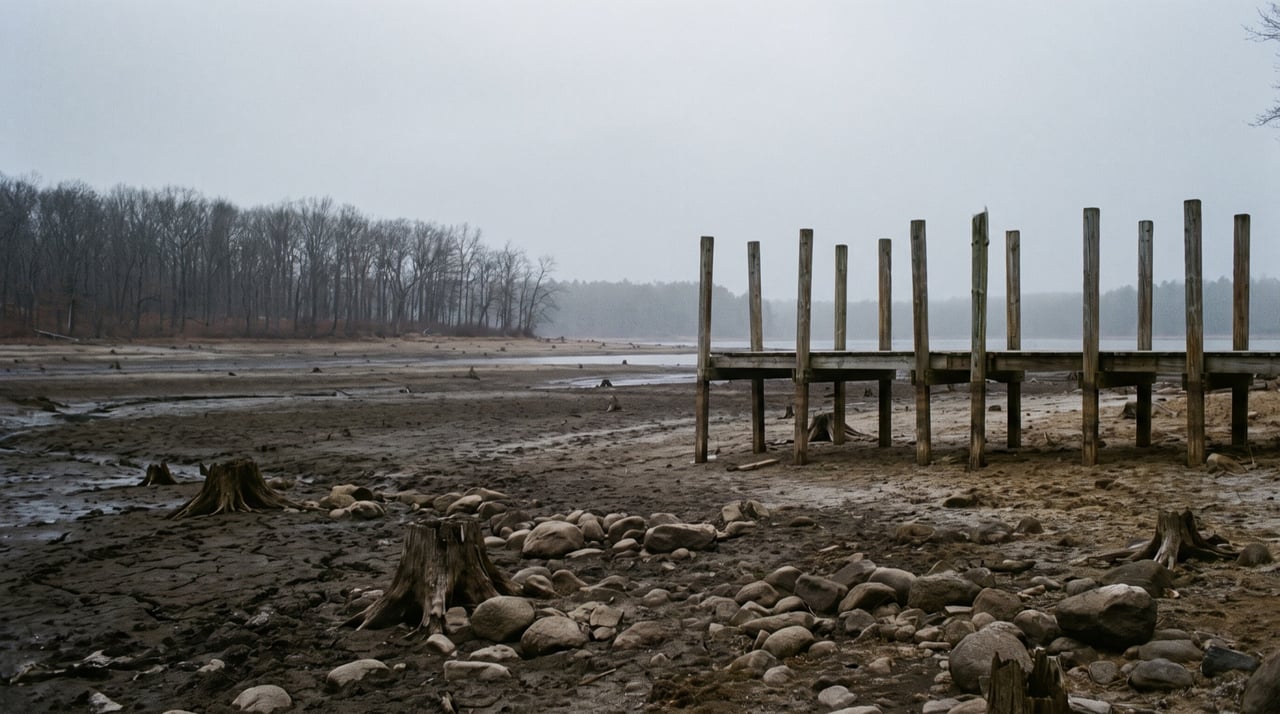
Every seller asks when to list. On most Connecticut houses the honest answer is that spring is busier and the rest is noise around the edges. On Candlewood the answer is different, because this lake physically changes between November and May, and what a buyer walks up to is not the same property in February that it is in July.
That is not a marketing line. The water level is drawn down every year, on purpose, and the difference is measured in feet.
The drawdown is the thing most sellers underestimate
FirstLight draws Candlewood down each year as part of normal hydroelectric operations, and the timing is later than most people assume. FirstLight says the drawdown "has typically been initiated between December and February," and points to warmer, wetter winters as the reason it has trended later. The Candlewood Lake Authority notes FirstLight may begin as early as November 1, but the last several seasons all started in January. The specific target elevations are set in a plan published each year, so the exact numbers change, but the shape does not: the lake generally holds near its summer operating range well past Labor Day, comes down over the winter, sits at its winter low, and refills in spring. It does not usually drop through late fall, sits at its winter low, and refills in spring.
At the winter low, shoreline that is underwater in July is mud. Docks sit on dry ground. Boats are out. Retaining walls, pilings, and the actual slope of the bank are all visible, which is genuinely useful to an informed buyer and genuinely alarming to an uninformed one.
I wrote up how the levels work and who controls the shoreline in who actually owns the shoreline on Candlewood Lake.
What this actually means for timing
The useful way to think about it is not "when do houses sell" but "what does my specific property look like at its worst, and does that help me or hurt me."
If your waterfront shows well at low water, winter is an opportunity, not a penalty. A hard bank, a well built dock on solid footings, a clean shoreline, deep water close in: those read as strengths when everything is exposed. You are also in front of a smaller, more serious pool of buyers with less competing inventory.
If your value is mostly in the summer experience, listing at the low is fighting yourself. A shallow cove, a long walk to usable water, a dock that only works at full pool: these are the properties that photograph and show far better in season, and where waiting is worth real money.
The mistake is treating the calendar as the variable when the property is the variable.
The other half of the timing question is documents, not weather
The parts of a lake sale that actually delay closings are documentary, and they take longer than sellers expect. Whether a dock is authorized and whether that authorization survives the sale is a paperwork question. So is where the Project Boundary sits relative to what you think you own.
If you intend to list in spring, the work starts in winter. That is the real seasonal advice.
- Dock and shoreline authorization. Confirm what is on file before a buyer's attorney asks. See your Candlewood dock permit does not come with the house.
- Septic. Get it inspected and pumped on your own schedule. Worth knowing that Connecticut does not license or certify septic inspectors, so who performs it matters.
- Well. Nobody is required to test it, which means problems tend to surface late rather than early.
- Your numbers. Know what you actually net before you set a price. I sorted the fixed costs from the negotiable ones in only one of your selling costs is set by law, and you can start with a valuation on your property.
A word on what I cannot tell you
I am not going to quote you a seasonal price premium or an average days on market by month. Those numbers get thrown around confidently in this market and most of them are built on sample sizes too small to mean anything. Candlewood waterfront turns over in modest numbers across five towns, split across categories that are not comparable to each other, direct waterfront against dock rights against association against proximity. Slice a small pool by month and by category and you are reading noise. I am deliberately not putting a figure on that pool here, because I would be doing exactly what I am objecting to: quoting a number without showing you the pull it came from. If you want the actual count for your town and property type, ask me and I will run it and show you the filters.
What I can tell you is what a buyer will physically see, what your property looks like at its worst, and what paperwork will hold up a closing if it is not handled first. That is the part of timing that is actually within your control.
What the 2025 to 2026 season actually did, from FirstLight's notices
The general rule above has a specific recent history, and it is worth reading as a seller because a buyer who toured last winter saw the lake at a level FirstLight had not planned. FirstLight's September 16, 2025 notice said it would "initiate the shallow drawdown season for Candlewood Lake, which includes Squantz Pond, after November 1, 2025, as weather conditions allow," noted that "in recent years, the annual drawdown of Candlewood Lake has typically been initiated between December and February," set the normal summer operating range at 429.5 to 427 feet with a shallow drawdown target of 424 feet and a winter pumping and generation range of 424 to 422 feet, promised a return "to normal summer operating ranges prior to Memorial Day 2026," and, because "exact dates and associated lake levels are not available," strongly encouraged homeowners to remove structures, boat lifts and docks before winter.
The drawdown itself started late. FirstLight's January 16, 2026 notice said it would "initiate the drawdown season for Candlewood Lake, which includes Squantz Pond, on Monday, January 19, 2026," as a shallow drawdown to 424 feet. Then on January 31, 2026 it announced it "must amend the ongoing drawdown plan for Candlewood Lake, by drawing it down up to 4 feet lower than originally planned," in response to a January 25 Department of Energy emergency order, number 202-26-03 under section 202(c) of the Federal Power Act, "the first 202(c) emergency order issued by DOE to ISO-NE since 2003," taking the lake "from the planned levels associated with a shallow drawdown (424'-422') to levels associated with a deep drawdown (420'-418')." The refill promise did not move: "the lake will return to normal summer operating ranges prior to Memorial Day 2026." The same notice warned about "ice shelves, ice drifts, and other hazards" and told the public to "proceed with extreme caution when venturing out onto the lake."
For a seller the sequence matters more than the numbers. A winter listing in the 2025 to 2026 season went from full pool in December to a shallow low in late January to a deep low in February, then back to summer level by late May, and nothing about that timetable was knowable in September. That is the argument for preparing the documents in winter and choosing the listing window by what your own shoreline looks like at its lowest, which last winter was two feet lower than the plan. Candlewood Lake's 2026 deep drawdown, what changed covers the order in detail, and the 2026 refill covers the way back up. FirstLight's notice for the 2026 to 2027 season had not been posted as of September 4, 2026; when it is, the dates in it replace everything above.
Sources: FirstLight, "FirstLight Annual Drawdown of Lake Zoar, Lake Lillinonah, and Candlewood Lake" (September 16, 2025), "FirstLight to Begin Annual Drawdown of Candlewood Lake on January 19" (January 16, 2026) and "FirstLight to Further Lower Candlewood Lake Water Levels in Response to Department of Energy Order to Support Grid Stability During Cold Snap" (January 31, 2026), all on firstlight.energy, read September 4, 2026. Elevations are FirstLight's own and change every season.
Common questions about when to list a Candlewood Lake home
When is the best time to sell a house on Candlewood Lake?
It depends more on the property than the calendar. Waterfront that shows well at low water can do well listing in the off season, when the buyer pool is smaller but more serious and there is less competing inventory. Property whose value is mostly in the summer experience, such as a shallow cove or a dock that only works at full pool, generally shows much better in season.
Does the winter drawdown hurt my chances of selling?
Not automatically. The drawdown exposes the bank, the dock footings and the true slope of the shoreline. On a well built waterfront that is an advantage, because a serious buyer can see exactly what they are getting. On a property whose appeal depends on full pool, it is a real disadvantage.
How far does Candlewood Lake actually drop in winter?
FirstLight draws the lake down annually, but not in early fall. FirstLight says the Candlewood drawdown "has typically been initiated between December and February." The October drawdown dates people see published usually belong to Lake Zoar and Lake Lillinonah, not Candlewood. Target elevations are published in a plan each year, so the numbers change annually. The pattern is consistent in shape but the timing runs late: summer operating range through the season and usually well into the fall, a drawdown that has recently begun in January, a winter low, then a spring refill. For a seller that cuts the other way from the common assumption, because an autumn listing normally still photographs full water.
What should I do before listing a lake house?
Handle the documents before the weather. Confirm dock and shoreline authorization is on file, get the septic inspected and pumped on your own schedule, consider testing the well even though nobody requires it, and know what you actually net before setting a price. These take longer than sellers expect and they are what delays closings.
Is spring really the best time to list in Connecticut?
Spring is busier across Connecticut generally. On Candlewood that general rule collides with a specific physical fact, which is that the lake is refilling in spring and was at its low weeks earlier. If you plan to list in spring, the preparation work belongs in winter.
Related reading:who actually owns the shoreline on Candlewood Lake, only one of your selling costs is set by law, and your dock permit does not come with the house.
More on this area:Candlewood Lake waterfront overview.
If you are weighing a sale and want an honest read on how your specific property shows at low water, start with a valuation on your property or reach me through ConnorCTHomes.com.
Connor Kostyra, Licensed Real Estate Salesperson, CT Lic. RES.0836348.
Connor CT Homes is a marketing brand. Real estate services are provided through RE/MAX Rise, 1297 Main Street, Watertown, CT 06795.
This article is general information, not legal advice. Drawdown elevations are set by FirstLight in a plan published annually and can change. Confirm current levels and shoreline rules with FirstLight and the Candlewood Lake Authority, and confirm permit questions with your town and a Connecticut real estate attorney.